Showing posts with label CODA. Show all posts

Thursday, March 03, 2016

The Sound of All Things by Myron Uhlberg-- an open fan girl letter instead of a review


I cannot believe it’s been seven years since I saw my friend Myron Uhlberg. In 2009 after a whirlwind of events over his memoir, Hands of My Father, Uhlberg finally came home to Gallaudet University. I’m pretty proud that I helped make that happen. 

He touched so many of our students and community members. I saw the former provost shed a tear when Uhlberg and he spoke of their fathers who were both from Brooklyn. 

I encourage you to search his name in the top left corner of this blog to share in the experience.

Last year Myron emailed me about his life and his forthcoming children’s book, The Sound of All Things. In his email, he wrote, 
“The book is scheduled for publication March 1, 2016, to coincide with Deaf History Month.  Which is most fitting—since SOAT (and its two sequels) cover a crucial period in that history.” 
Of course he planned it this way. His love for the Deaf Community resonates in all of his publications. I could go on and on about what a beautiful human he is but I’m supposed to be reviewing his new book. 

I'm afraid this is going to be more of an open letter from a fan girl.


I cried when I received it. Before I even opened the package, I teared up because I know the story. Here is a man who in his later years (ha, he’ll give me the stink eye for that phrase) he’s still writing about his parents. I once read that our loved ones who have passed are kept alive when we remember them. Myron’s parents are looking down at him still and beaming with pride over their son. 

The Sound of All Things is the story of the hearing boy with Deaf parents. They go to Coney Island and one of the first scenes is the boy and father riding a roller coaster. The father asks the son to describe what things sound like and through Sign Language the son does his best… but how does one describe such things as the waves. In all good children’s books and in life, the best way to answer this question is to ask a librarian. So the young boy goes to the library, finds the more-than-competent librarian who finds a book of poetry. “Some of the poems are about the ocean”, she tells the young boy (no citation since my review copy does not have page numbers). They find the perfect passage.

I don’t want to give away all the precious details of the story but it ends with the visuals of fireworks and a young boy reading a library book so that he can share another aspect of his world with his father.

Myron ends his book with a note from the author. 

I'll end with this. Myron, I miss you. We miss you!  And, we do look forward to you coming home again.  

Saturday, November 12, 2011

CODA author Kambri Crews, Burn Down the Ground:A Memoir (2012)

Burn Down the Ground: A Memoir by Kambri Crews
Hardcover: 352 pages
Publisher: Villard (February 28, 2012)
Language: English
ISBN-10: 0345516028
ISBN-13: 978-0345516022  

Book Description
Publication Date: February 28, 2012
In this powerful, affecting, and unflinching memoir, a daughter looks back on her unconventional childhood with deaf parents in rural Texas while trying to reconcile it to her present life—one in which her father is serving a twenty-year sentence in a maximum-security prison.
As a child, Kambri Crews wished that she’d been born deaf so that she, too, could fully belong to the tight-knit Deaf community that embraced her parents. Her beautiful mother was a saint who would swiftly correct anyone’s notion that deaf equaled dumb. Her handsome father, on the other hand, was more likely to be found hanging out with the sinners. Strong, gregarious, and hardworking, he managed to turn a wild plot of land into a family homestead complete with running water and electricity. To Kambri, he was Daniel Boone, Frank Lloyd Wright, Ben Franklin, and Elvis Presley all rolled into one.


But if Kambri’s dad was Superman, then the hearing world was his kryptonite. The isolation that accompanied his deafness unlocked a fierce temper—a rage that a teenage Kambri witnessed when he attacked her mother, and that culminated fourteen years later in his conviction for another violent crime.

With a smart mix of brutal honesty and blunt humor, Kambri Crews explores her complicated bond with her father—which begins with adoration, moves to fear, and finally arrives at understanding—as she tries to forge a new connection between them while he lives behind bars.
Burn Down the Ground is a brilliant portrait of living in two worlds—one hearing, the other deaf; one under the laid-back Texas sun, the other within the energetic pulse of New York City; one mired in violence, the other rife with possibility—and heralds the arrival of a captivating new voice.

Thursday, October 22, 2009

Gallaudet's writer-in-residence Myron Uhlberg's presentation


Writer-in-residence Myron Uhlberg presented today, or rather told three dynamic stories, about his childhood and his Deaf parents to the Gallaudet University community this afternoon in Elstad Auditorium. Uhlberg, although I think I can call my friend Myron, began with a story about how his parents always considered him such a strange kid. He explained that to be like his father whom he so admired (although I shouldn't use the past tense here because it is clear that everything he does is still to earn the respect of his father and mother whom have both passed) he put bubble gum in his ears as a young boy to make himself deaf. 


While his first story was humorous, the second story about his boxing performance had the audience rolling. Lastly, Myron recounted how his father, a printer by trade, would make printer's hats for him. Young Myron, and I would argue the adult Myron too, so loved these hats that he would often beg him mother to allow him to  sleep in them. 


While I could go on and on about how much I adore Myron Uhlberg (I do! This professional crush tops them all-- move over Josh Swiller and David Mack... okay, I'm still crushing on all of you), my favorite part of his personality is how he connects with our Gallaudet students. When I first had the idea to bring him to campus, I knew how fascinating I found Myron once he started storytelling, but I wasn't sure if a gentleman in his 70's would be able to capture the attentions of 18-year-old freshmen. During his February visit, he captured the hearts of so many. Today's presentation was no exception. He made us laugh and cry! His final message to our students was for them to go write their own stories, "It isn't hard. You write a story from your heart... a true story for you!"


Videos to come!!!

Friday, October 16, 2009

CODA Author Myron Uhlberg returns to Gallaudet University


It may not come as a surprise to anyone that Gallaudet University's First Year Experience program annual Common Reading book selection is Hands of My Father: A Hearing Boy, His Deaf Parents, and the Language of Love by Myron Uhlberg. After a presentation on April 14 by Common Reading Committee members, community members expressed positive feedback for both Mr. Uhlberg’s new publication as well as his February campus visit which was well-received by students, faculty and staff. Uhlberg is a critically acclaimed award-winning author of several children's picture books (Dad, Jackie & Me, The Printer) that often include accounts of his Deaf parents.
The committee felt that Hands of My Father provides a framework for community members to interact while creating a sense of community in and outside the classroom, and looks forward to the numerous intellectual discussions that will derive from this memoir.
 
This week, Gallaudet's Daily Digest posted:
Presentation by writer-in-residence Myron Uhlberg
Myron Uhlberg will speak about his groundbreaking book, Hands of My Father: A Hearing Boy, His Deaf Parents, and the Language of Love, on Thursday, October 22 at 12:30 p.m. in Elstad Auditorium. This public presentation is the culmination of Mr. Uhlberg's three-week stay at Gallaudet University as a writer-in-residence.


Mr. Uhlberg's book is the Common Reading selection for all first-year students for the 2009-2010 academic year. He is currently visiting all GSR 101 classes, and other classes by invitation, and will also meet Kendall Demonstration Elementary School and Model Secondary School for the Deaf students and teachers.


http://aaweb.gallaudet.edu/Daily_Digest/EventXite_-_Announcements/Public_Presentation_by_Writer-in-Residence_Myron_Uhlberg_.html

Monday, June 15, 2009

CODA Characters and other Resources for Deaf Parents with Hearing Children

Thanks to Tom Bull for providing this list of RESOURCES FOR DEAF PARENTS WITH HEARING CHILDREN fact sheet. Also, I have a few other books with CODA characters....

Hardcover: 576 pages
Publisher: Ecco (September 19, 2008)
Edgar uses sign language to communicate. Louise Wilkes is a CODA and communicates using the Sign Language that her Deaf parents taught her. This character works with Deaf children and hearing children of Deaf parents. There is another secondary Deaf Character whom Edgar meets when he is four. The character communicates through Sign Language but also speaks. Edgar notes that he sounds funny (p. 49).

At Face Value (October 2008) by Emily Franklin
Paperback: 264 pages
Publisher: Flux
Linus', a staff writer at the Word, has a father who is deaf. Linus teaches main character Cyrie sign language and the two use it throughout the book.

This book is written by a CODA author......

The Silent Time by Paul Rowe (September 2007)
Publisher: Killick Press.
The deaf character, Dulcie attends the Halifax School for the Deaf in the early 1900s, similar to the author's late mother, Elizabeth Rowe. (This is one of my all-time favorite books!)


Sunday, February 08, 2009

Myron Uhlberg comes HOME to Gallaudet University

I have been planning this visit for months and dreaming about it even longer. The week was a whirlwind. First, the book Hands of My Father was selected by Amazon as one of its Best of February selections; then, the book was released; there was a review printed in the Wall Street Journal, and finally Myron Uhlberg, having never stepped foot on Kendall Green, came “Home” to Gallaudet University.
Myron revealed that he was extremely nervous about this visit stating “It’s Gallaudet University. What if Deaf people don’t understand my old rusty sign language”. While he insisted upon interpreters throughout his visit which Gallaudet University provided, I noted presentation after presentation a group of fairly bored interpreters. He walked into each new situation signing without voice. To say that our students loved him would be an understatement. Dr. Bob Weinstock, assistant to the Provost and the man who brought my idea into fruition, called Myron a “veritable rock star.” The freshmen class that he initially visited had created questions for him but once Myron began his story, he did not stop and we had to whisk him off to the next event.
During the luncheon sponsored so graciously by the provost’s office, Myron met faculty and staff members whom I consider to be some of the leading researchers in literature with Deaf Characters. Dr. Cynthia Bailes, librarian Diana Gates, and graduate student Cheryl Shahan were some in attendance. Again, Myron got lost in his story and we had to whisk him away for the campus tour.
For me, the tour given by Ms. Brooke Budzinski, interim coordinator of the Visitors Center was one of the best parts of Myron’s visit. Myron was able to actually see the campus and again and again, he mentioned how beautiful it was and how lovely the people were. Perhaps I overlook our campus’ hospitality on a daily basis but everyone signed greetings to Myron throughout his visit. On the tour, Ms. Budzinski shared numerous facts about the campus and its history; I even learned a thing or two. We entered the President’s Office and Myron was introduced to Dr. Davila who spent nearly fifteen minutes discussing the past. Dr. Davila had known Myron’s father. After that, he considered the entire visit a success since Myron’s father, Lou Uhlberg, was one of the main reasons for this visit. At 75, Myron still very much wants to impress his father with his book and his visit to THE University for the Deaf. He told me that seeing the young people signing on campus reminded him again and again of his parents. His visit with Dr. Davila was not the last time that he would become emotional during his stay.
During his visit with Professor Matt Malzkuhn’s class, Myron met a student who was also from Brooklyn. Their regional signs matched and there was no turning back as a newly confident Myron told his story. Although he continually asked for new signs, he refused to change his “old” sign for PICTURE and I’m not even sure if he caught it himself when he mumbled in sign “my father taught me that.” I can’t imagine anyone wanting to change him. Male and female college students hugged him at the end of each meeting; children tugged at his limbs and sat in his lap; grown men cried.
There was only a half hour of down time before his evening presentation. While a few technology glitches were resolved, Myron, who confessed that he just found out that he himself had the proud label of CODA, met a young boy with Deaf parents. Myron, oblivious to the crowd of adults who had come to meet him, stopped everything to make a printer’s hat for the boy who had read his books. He showed the boy exactly how his father had folded each piece. After a dynamic presentation where Myron became the characters in his book and only once used interpreters while he read a short excerpt, I suggested going off campus for dinner. It was around 8pm after an impromptu book signing but Myron wanted to stay on campus to see the students. We dined in the Rathskeller among students and a few faculty members. Myron ate a veggie burger and fries.
Friday was an early rise. We met for breakfast and with class visits to the students at Kendall and MSSD, Myron already had his newspaper ready. The first stop was a “short” visit to the Provost’s office. Dr. Weiner greeted Myron as a long lost friend. “Call me Steve,” he signed and the two entered the office with possibly the best view of Gallaudet University, if not Washington, D.C. It is impossible to do it justice by documenting the events that occurred during this visit. Dr. Weinstock and I watched two men discuss Brooklyn, their fathers, and while Myron made “Steve” a printer’s hat I believe he channeled one of their fathers. In those moments, men became boys. I don’t think I have ever seen two people so happy nor nostalgic.
Nearly a half hour late to Ms. Janet Weinstock and Ms. Mary Ann Seremeth’s MSSD class, Myron discussed his books. I was copied on numerous pages reading that we were indeed late but on our way and that from what we have seen Myron Uhlberg would be signing for himself using “Brooklyn Sign Language circa 1940s.” One of my goals of this visit was for others to understand why I loved Myron so much. I did not have to convince anyone once he stepped foot on campus.
An ardent time keeper, we had one final meet and greet with the children at Kendall Elementary school. An animated Myron teased, made printer’s hats, and showed pictures from his books. It was hard to pull him away from this “presentation” for these were the readers for whom he had written his children’s books.
His last and final stop was the Bison Shop where bookstore manager, Ms. Priscilla O'Donnell, had prepared a book signing along with a beautiful display featuring Myron’s books. When Myron does a book signing, he writes short novels not just his name, shakes hands, and listens to others’ stories. I am so honored to be considered his friend and I don’t think I’ve ever been so proud to be part of Team Gallaudet.
His brief visit had ended. In the car he called his wife and said that this was the trip of a lifetime. Gallaudet had stolen his heart just as I believe he had stolen many of ours. While driving up to the Dulles airport, Myron quoted one of my favorite authors. “F. Scott Fitzgerald wrote ‘There are no second acts in American lives’. Fitzgerald was mistaken.” Myron hugged me and with that, I said goodbye to my friend.

Tuesday, February 03, 2009

Author Myron Uhlberg Scheduled to Visit Gallaudet University

Daily Digest

Noted author and CODA Myron Uhlberg will read from his new book, Hands of My Father, on Thursday, February 5, 5-7 p.m., in the Sprint Multipurpose Room, I. King Jordan Student Academic Center.

Autographed copies of the book will be available for purchase through special arrangement with the Bison Shop.

Hands of My Father is a critically acclaimed book about the relationship between a hearing child and his deaf parents. The book, to be published on February 3 by Random House, is one of seven "Best of February" selections on amazon.com. Mr. Uhlberg's previous books include the children's classic Dad, Jackie, and Me, which has won 28 awards. Mr. Uhlberg will visit General Studies classes at Gallaudet and elementary and high school classes at the Laurent Clerc National Deaf Education Center during his two-day visit.


The public presentation on February 5 is sponsored by the Office of the Provost and the Program of General Studies.Come one, come all!

Thursday, January 15, 2009

19 days until Myron Uhlberg's book release.... and his visit to Gallaudet!!!

Hands of My Father: A Hearing Boy, His Deaf Parents, and the Language of Love by Myron Uhlberg will be released on February 3, 2009. I have been mentioning this book for quite some time so I'm thrilled that Myron Uhlberg will be making his way to Gallaudet University for the release of his memoir. During the IRA Convention, I met and instantly adored Mr. Uhlberg. I laughed and cried during his presentation about the legacy of his parents, Sarah and Lou Uhlberg. It was an absolute honor to attend his presentation then as it is to call him "friend" now.
If you're like me and you just can't wait to read the book (luckily I received an advance copy months ago), check out his essay "Language Instincts" provided by Amazon.com.

"Language Instinct"
View SlideShare document or Upload your own.

Friday, January 02, 2009

Sign Language and Secondary Deaf Character in Oprah's Book Club text, The Story of Edgar Sawtelle

I've hesitated adding this book to my blog because the story is about main character Edgar who is described as "mute". Folks keep bringing this book to my attention and it is one of Oprah's Book Club reads....

Edgar uses sign language to communicate. Louise Wilkes is a CODA and communicates using the Sign Language that her Deaf parents taught her. This character works with Deaf children and hearing children of Deaf parents. There is another secondary Deaf Character whom Edgar meets when he is four. The character communicates through Sign Language but also speaks. Edgar notes that he sounds funny (p. 49).

The Story of Edgar Sawtelle: A Novel by David Wroblewski
Hardcover: 576 pages
Publisher: Ecco (September 19, 2008)

Book Description
Born mute, speaking only in sign, Edgar Sawtelle leads an idyllic life with his parents on their farm in remote northern Wisconsin. For generations, the Sawtelles have raised and trained a fictional breed of dog whose thoughtful companionship is epitomized by Almondine, Edgar's lifelong friend and ally. But with the unexpected return of Claude, Edgar's paternal uncle, turmoil consumes the Sawtelles' once peaceful home. When Edgar's father dies suddenly, Claude insinuates himself into the life of the farm--and into Edgar's mother's affections.
Grief-stricken and bewildered, Edgar tries to prove Claude played a role in his father's death, but his plan backfires--spectacularly. Forced to flee into the vast wilderness lying beyond the farm, Edgar comes of age in the wild, fighting for his survival and that of the three yearling dogs who follow him. But his need to face his father's murderer and his devotion to the Sawtelle dogs turn Edgar ever homeward.

Sunday, December 07, 2008

Deaf Character book selected to be on the Virginia Young Readers' Choice List

Congratulations to Myron Uhlberg! His picture book Dad, Jackie, and Me has been selected to be on the Virginia Young Readers’ Choice list for 2009-2010. This children’s choice award is sponsored by the Virginia State Reading Association. Winners will be announced officially in May 2010.

Wednesday, November 26, 2008

ALAN Breakfast speaker, Sharon Creech and her CODA character

The last few weeks have been increasingly hectic with the end of the semester approaching. I arrived home late Sunday night and didn't have time to post anything about the wonderful time I had at the ALAN Breakfast at the NCTE Convention in San Antonio, Texas.
Laurie Halse Anderson, (pictured left) author of Speak, was presented with the 2008 ALAN Award. She was absolutely hysterical making fun of some of the required reading that was forced to read in school. She mentioned The Scarlet Letter and made a horrible face. Following her award, the ALAN breakfast speaker, Sharon Creech (pictured right) delivered her inspiring message about reaching students like a young Laurie Halse Anderson. Creech is the best-selling author of the Newbery Medal winner Walk Two Moons, and the Newbery Honor Book The Wanderer. She is also the first American in history to be awarded the CILIP Carnegie Medal for Ruby Holler. During the breakfast, she spoke about her book, Love That Dog. The first time I read Love That Dog I cried... the story is that good. Creech's recent book, Hate That Cat: A Novel, picks up another year of Jack's life with teacher Miss Stretchberry. The exciting thing is... and it was a shocker for me during her presentation... Creech gives us more information about main character Jack's life. Readers even discover that Jack is a CODA- his mother is Deaf and uses sign language to communicate! Can you imagine how excited I was sitting at the ALAN Breakfast and finding out about a Deaf Character being added to her recent novel?!? I love how life is full of surprises. Jack's mother is a minor character but still....

Hate That Cat: A Novel by Sharon Creech
Reading level: Ages 9-12
Hardcover: 160 pages
Publisher: Joanna Cotler (September 23, 2008)
ISBN-10: 0061430927

Sunday, October 26, 2008

CODA Character in At Face Value

At Face Value (October 2008) by Emily Franklin
Paperback: 264 pages
Publisher: Flux

Linus', a staff writer at the Word, has a father who is deaf. Linus teaches main character Cyrie sign language and the two use it throughout the book.

Product Description
You've never seen a nose as big as mine. In this modern love story, Cyrano de Bergerac is reinvented as a brilliant and funny seventeen-year-old ...girl. A tennis champion, straight-A student, and editor of the school paper, Cyrie Bergerac has learned to live with her (ahem) peculiar proboscis. And she's got an armoury of witty retorts for every schnozz joke that comes her way. But despite her talents and charm, Cyrie is convinced that no guy-hot or otherwise-would deem her crush-worthy.Certainly not Eddie 'Rox' Roxanninoff, who's gorgeous, smart, and genuinely nice to boot! There's someone else smitten with Rox, too. It's Leyla, Cyrie's pretty yet tongue-tied best friend. Helping Leyla seduce Rox through email provides a wonderful way for Cyrie to express her true feelings. But watching her crush hook up with Leyla may be more than she can take. Will Cyrie find the strength to risk it all-nose be damned-and confess her love? In this funny and poignant spin on a classic, popular YA author Emily Franklin explores the age-old theme of 'true beauty' with humour and piercing perception.

Thursday, October 23, 2008

The Silent Time slated for a Heritage and History Book Award

The Historic Sites Association partners with the Writer's Alliance of Newfoundland and Labrador to present a Heritage and History Book Award for a work of fiction, non-fiction, poetry, or young adult/children's literature that exemplifies excellence in the interpretation of the history and heritage of Newfoundland and Labrador. A shortlist is selected and the winner is announced in December of that year. Let's cross our fingers because The Silent Time by Paul Rowe has made the short list!!! I read it last December and it became one of my favorite reads of the year.... and is still one of my favorites. The deaf character, Dulcie attends the Halifax School for the Deaf in the early 1900s, similar to the author's late mother, Elizabeth Rowe. The plot is amazing!

Sunday, October 05, 2008

Captioned Video: Myron Uhlberg speaks of The Hands of My Father

Before, I posted the version that was not yet captioned. Three days ago this captioned version was made available. Here is the captioned version of Myron Uhlberg discussing his forthcoming book, Hands of My Father.

I've also updated the earlier post with this video.

Thursday, September 18, 2008

Video Update: Myron Uhlberg

Both of the videos featuring author Myron Uhlberg are currently in the process of being captioned. Once these are available, I will upload them.

Tuesday, September 16, 2008

Video: Myron Uhlberg speaks of The Hands of My Father

This video includes Myron Uhlberg discussing his upcoming memoir, The Hands of My Father. Because it isn't closed captioned, I transcribed the video below... It's worth a watch for the beautiful pictures of Uhlberg's family. Have I mentioned that I can't wait to read this book?!?


For me of course my story is the centrality of my life. Everything begins and ends with me the fact that I was the first born hearing child of two deaf parents. But I knew the title could only be The Hands of My Father because when I think, and thought, and lived with my father when he was alive, to me the essence of my father was his hands. His language was in his hands. His language defined him… his culture.. his thoughts… his history everything was in his hands. About the time I was six years old I became officially my father’s translator. I was the interface between my father’s deaf world and the hearing world.
My mother at the age of 89… She couldn’t live alone anymore so I brought her to live with me. And every other day she would tell me “I want to die.. I want to die” and in Sign Language “I want to die” is the turning of the body (SIGNS DIE) . And then I said “Wait Wait Wait, Don’t die yet. I wrote a book” One day the book showed up and we sat down and I’ll never forget and I showed her the book and she traced with her hand the title Flying over Brooklyn by the author Myron Uhlberg and I could see in her expression how excited she was and when we came to the end there is a picture of my mother and she is holding her son, ME, by the shoulder and she is looking out the window at what’s left of this colossal blizzard in 1947. She turned and looked at me pointed to the woman in the illustration and said “Me” and I said “Yes, that’s you the mother that I love” (SIGNS LOVE) She started crying. And of course, I broke into tears as well. And at that time, she said “Why don’t you write about us. But talk about Lou..My husband Lou”. She always referred to my father as her husband Lou like he this was some strange other person who was not in fact my father. With adult audiences what happens is when I tell them my story, first they’re fascinated at learning about this complex invisible world in plain sight. Most of them have never interacted with a deaf person. They don’t realize that it’s a real language as opposed to just mimicking or miming something. They don’t realize there is a culture involved. They no nothing about… they’re absolutely fascinated. It’s a glimpse into this invisible world now made visible. There is a rather large segment of the community who the only way they understand the world around them is through their language…and their language is in their hands. And that’s a beautiful full rich complex language. And however it creates… problems of being deaf in the hearing world is the further appreciation of what those problems are. And that’s what I hope is the lasting remembrance of my story.

Thursday, September 11, 2008

Myron Uhlberg- Excerpt from New Book (ASL interpreted)

Myron Uhlberg - Excerpt Reading/Sign Language Interpretation

I'm sorry this isn't captioned.

Saturday, September 06, 2008

Interview with Myron Uhlberg regarding his forthcoming memoir HANDS OF MY FATHER

Last May, I flew to Atlanta, GA for one day to The International Reading Association (IRA) Convention for Myron Uhlberg’s presentation “DAD, JACKIE, AND ME: Deaf, Black, and Hearing: What's the Connection? The Stories Behind the Story”. You can read my May 11 post about the experience. Since that meeting, I requested an interview with Myron to discuss his previous publications and his forthcoming memoir, Hands of My Father: A Hearing Boy, His Deaf Parents, and the Language of Love. It was an absolute honor to attend his presentation and it is an honor to be able to discuss his books with him. He’ll tell you that he started writing books in his 60’s; however, I’m sure he’s been telling stories much longer than that. I can’t wait to get my hands on this book!
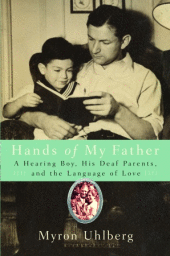
Hands of My Father: A Hearing Boy, His Deaf Parents, and the Language of Love by Myron Uhlberg
Hardcover: 256 pages
Publisher: Bantam (December 30, 2008)
Language: English
ISBN-10: 0553806882
************************Interview*************
SPW: How did you decide to include your parents as the deaf characters in your books?

MU: When I began to write books for children I struggled to find what every writer looks for, a voice—and a topic. Prior to beginning this, rather belated, second career at the tender age of sixty-two, I had done much research on the genre of children’s literature. Then, as a former businessman, I created a business plan. That plan included reading every picture book—from A to Z—in the main branch of my public library. I would type out what I intuitively felt were the best books, thereby gaining a feeling for the words used and the structure of the story. Having gone through the collection from A to Z, I then read each book in the collection again, this time backwards--from Z to A, on the theory that I would catch any books that had been previously out on loan. Then I began to write. And write. And write some more. (I was seemingly pretty prolific.) At first, I wrote about many things: mean dogs, and the natural fear of them by most children; variations on classic folktales, as well as many other diverse subjects.

After completing a story I would immediately send it off—rather willy-nilly—to a publisher—any publisher. When I went to my mailbox to send out a story, I would find in it a story being returned from a previous submission. Basically, all I was accomplishing with my strategy (actually, no strategy) was the benefit of the exercise of walking to and from my mailbox. (My blood pressure actually went down five points during this exercise cycle.) The typical pro- forma rejections from editors would occasionally contain a personal comment, such as: “Dear author, nice story, but if we needed another story by Maurice Sendak, we would ask him, not you, to write it.” You see, I had read so many picture books, and had internalized so many of them, that I was writing in their voice. (Well, at least, I had good taste.)

When the rejection letter pile reached a height that even I found to be impressive, I stopped, and regrouped. It was at this point that I decided to forget about writing what I thought publishers wanted to see and, instead, I began writing the themes and subjects I wanted to explore. And those were about the interface of the deaf and hearing world; the world I had grown up in—the world of a hearing boy raised by a deaf mother and father.

SPW: What type of research did you do to become a children’s author?

MU: Each of my books required different levels of research. For example: In Flying Over Brooklyn the setting is the blizzard of 1947. At the time, I was thirteen-years-old. Since that was over sixty years ago, I had to examine the archives of The New York Times to test my memory as to actual details of the storm. My concern was that I had—in memory—exaggerated the extent and depth of the snowfall. It turns out, I hadn’t. For Dad, Jackie, and Me—also set in 1947—I had to research the entire baseball season of that year, paying particular attention to the impact that Jackie Robinson, the first black baseball player to play in the major leagues, had on baseball, his team, the fans, and, in fact, on all of America. For my latest book, an adult memoir, Hands of My Father: A Hearing Boy, His Deaf Father, and the Language of Love, I immersed myself in my father’s old family photograph albums. I spent countless hours and days lost in those old black-and-white photos. Like Proust’ Madeleine they instantly brought back my deaf world of seventy years ago.

SPW: What inspired you to write?

MU: My original inspiration was to become a published author, so that—as I imagined it—my first-born granddaughter, Alex, would invite me to her school for an author visit. How proud she and I would be. However, it took many years before my first book was accepted, and so it was that Alex was in middle school by the time it was published. But by then, her younger sister, Kelli, was in grade school . . . and one day, she met me at the door of her school (all emblazoned with banners announcing my visit) and took me by the hand to every class, and introduced me as her grandfather, the author.

SPW: What do you hope that readers will learn or take away from your books?

MU: The world of the deaf is invisible to the larger hearing world—invisible in plain sight. It is only when the hands of the deaf come alive and begin to speak the beautiful language contained in them that the hearing are aware of the deaf world. I hope my books about this world will make visible to the hearing how beautiful is the language of the deaf—American Sign Language—and how that language lies at the heart of deaf culture; just as every language does in every culture in every part of the world. Furthermore, I hope that children who read my book gain a reinforced understanding of the diversity that exists within the human condition.

SPW: When is your next book going to be in bookstores?

MU: My next book, published by Bantam, is an adult memoir titled, HANDS OF MY FATHER. It will be in bookstores January/February 2009. This memoir has as it genesis my children’s books, THE PRINTER, and DAD, JACKIE, AND ME. It is the story of my growing up the first-born hearing child of two deaf parents in Brooklyn, New York, during the Great Depression and WW II. At the heart of the book is the boy’s love for his mother and father, a love that is confused with shame. At the age of six the boy becomes his father’s interpreter, and the human interface with the hearing world. After an initial—quite short, actually—period of time where the boy feels great pride in the role of interpreter for his father, he soon becomes disenchanted at the prospect of spending his childhood years acting in such a grown up capacity. The book recounts how the hearing boy blends his life in the hearing world with his life in his silent deaf world, and the adjustments he must make between being a child and acting as an adult—along with being a buffer, and protector, between his deaf father and the often hostile, uncaring hearies (his father’s term for hearing people). Woven throughout the book are vivid descriptions of the expressive beauty of his parent’s deaf language, American Sign Language, the boy’s first language.

SPW: What advice would you give to young people who are reading your books for the first time?

MU: I would suggest that after reading the story they ask themselves the question: Am I any different from the characters I’ve just read about?

SPW: Anything else you would like to add?

MU: As a child growing up, I was never a writer. Perhaps that was because Sign was my first language, and in Sign you write on air: there is no written sign language. But I did read. Reading was my first true passion, and it remains so to this day. A lifetime habit of reading—among only one of its many virtues—is the best foundation for being a writer. For anyone who reads any of my books—child or adult¾and thinks (as did I for so many years): “I wish I could be a writer,” I would ask them to consider my story. I did not decide to be a writer until I was sixty-two. My first book was published when I was sixty-six. I’ve been often asked, “Where did you get your imagination?” I have no imagination. I just write about what I know about: my life. Since everyone who wishes to be a writer has also had a life (and each life is unique in its own way) they have within them endless material for an endless amount of books. So the best advice I have to anyone who wishes to be a writer is: Write.
***********************************************************************************
Product Description
By turns heart-tugging and hilarious, Myron Uhlberg’s memoir tells the story of growing up as the hearing son of deaf parents—and his life in a world that he found unaccountably beautiful, even as he longed to escape it.“Does sound have rhythm?” my father asked. “Does it rise and fall like the ocean? Does it come and go like the wind?”Such were the kinds of questions that Myron Uhlberg’s deaf father asked him from earliest childhood, in his eternal quest to decipher, and to understand, the elusive nature of sound. Quite a challenge for a young boy, and one of many he would face. Uhlberg’s first language was American Sign Language, the first sign he learned: “I love you.” But his second language was spoken English—and no sooner did he learn it than he was called upon to act as his father’s ears and mouth in the stores and streets of the neighborhood beyond their silent apartment in Brooklyn. Resentful as he sometimes was of the heavy burdens heaped on his small shoulders, he nonetheless adored his parents, who passed on to him their own passionate engagement with life. These two remarkable people married and had children at the absolute bottom of the Great Depression—an expression of extraordinary optimism, and typical of the joy and resilience they were able to summon at even the darkest of times.From the beaches of Coney Island to Ebbets Field, where he watches his father’s hero Jackie Robinson play ball, from the branch library above the local Chinese restaurant where the odor of chow mein rose from the pages of the books he devoured to the hospital ward where he visits his polio-afflicted friend, this is a memoir filled with stories about growing up not just as the child of two deaf people but as a book-loving, mischief-making, tree-climbing kid during the remarkably eventful period that spanned the Depression, the War, and the early fifties.
About the Author
Myron Uhlberg is the critically acclaimed and award-winning author of a number of children’s books. He lives with his wife in Santa Monica and Palm Springs.