Saturday, October 20, 2007

Interview with Megan McDonald, author of American Girl's Changes for Julie

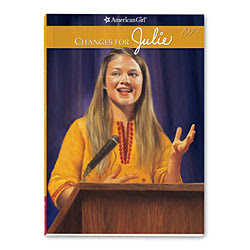
Changes for Julie
(American Girls Collection)
by Megan McDonald
Reading level: Ages 9-12 Paperback: 104 pages
Publisher: American Girl (September 2007)
ISBN-10: 1593693540
(first mentioned on this Blog September 8, 2007)

Changes for Julie is the last in a series of six historical books that take place in the 1970s. The book set includes: Meet Julie; Julie Tells Her Story; Happy New Year, Julie; Julie and the Eagles; Julie’s Journey; and Changes for Julie.

Joy, a new deaf student at school who uses sign language and lipreading to communicate, has trouble understanding what her teacher is saying when the teacher writes on the board. Julie understands what it is like to be new so she writes her new friend a note to Joy to tell her what was said. Unfortunately, there is a no note-passing rule in the classroom and Julie is sent to detention where she has to write ridiculous sentences over and over again. Determined to change the rules for detention and the system itself, Julie decides to run for student body president. Her choice for vice president is Joy. The two girls face several challenges. For starters, they are fifth-graders and the class president has always been a sixth grader; they are running against the most popular guy in school; and Joy isn't so popular. In fact, some of the girls in her grade say that "she sounds so weird when she talks" (p.28) and that her speech "sounds like she's inside a fishbowl" (p. 45). Will Julie compromise her principles? Will she win the election? Will sign language save the day? You've got to read the book to find out!

Megan McDonald is the author of numerous children's and young adult books, including the popular Judy Moody series. From her website, you will learn that she has two dogs, two horses, and fifteen wild turkeys; she begins writing her books on napkins; and, when she was a child, she collected bugs, toothpicks, scabs and Barbie doll heads. Now that she is an adult, she lives with her husband in California. She has a B.A. in English and a Masters in Library Science. Despite her busy schedule and book tour in Los Angeles, Chicago and New York, I was able to interview Megan McDonald about her recent book, Changes for Julie. Check out the interview below.
************************************************************************
SPW: How did you decide to include a deaf character who uses sign language? What kind of research did you do in order to make the character Joy appear like a real deaf adolescent and be historically accurate in the content?

MM: When I was growing up in the 1970s, my mother, a social worker, worked with kids with disabilities, some of whom were deaf. She was a great advocate for these children, and believed strongly in raising awareness about such disabilities. As a result, I grew up learning to have empathy, treat people with disabilities kindly and fairly, and not be afraid of kids who were "different" from me. In retrospect, disability rights was an important issue in the 1970s, and I felt strongly that this should become a theme of one of the Julie books. Research helped me to set Joy's deafness in historical context, and I did consult sign language manuals to help me with signs I could not remember from experience.

SPW: In the book, you describe some of signs that Joy and Julie use in sign language in great detail. How were you able to describe such signs? Did you take a sign language class, consult with someone, or learn from a book?

MM: From the time I was in high school, I tried to learn some sign language so I could hold conversations and sing songs etc with the kids my mom worked with. When I got to college, I took some classes in sign language. I went on to work in public libraries, where I often had the opportunity as a librarian to tell stories in sign for deaf children. And I had a friend who was deaf who worked at the library---even though she signed REALLY fast, she was very patient with me and my finger spelling, and we'd often laugh over funny mistakes I made when signing. When I was finished with the manuscript, a consultant did read and give feedback with an eye toward accuracy.

SPW: Has Joy appeared in any of the other American Girl books? Do you have plans for her character or any other deaf characters in future books?

MM: Since the character of Joy Jenner was not introduced until Book 6, she doesn't appear in any of the other Julie books preceding this one. I don't have any specific plans for another deaf character, but I find signing such a beautiful and appealing language, that you never know. Maybe Judy Moody will learn sign language one of these days.

SPW: What do you hope young readers will gain from Changes for Julie and its characters?

MM: I tried to realistically portray reactions to Joy. In other words, I did not shy away from showing that kids can be hurtful and unkind to someone with a disability such as deafness. My hope is that reading about such a character raises awareness and humanizes them so that kids don't have to be afraid of such differences. As in the story, once kids get beyond the "disability" and see the real person, true friendship can result.

SPW: What advice would you give to young people who are reading your books for the first time?

MM: My hope and aim is that readers will always be able to see themselves in a character or story they are reading about and identify with my characters. If readers are able to journey along with Julie, they will expand their minds and imaginations and world, alongside of my character. I hope kids will take away from my books the idea that they have it within them to rise to any challenge, no matter how difficult.***************************************************************************
For more information about Megan McDonald, visit http://www.meganmcdonald.net/
To learn more about the American Girl collection, visit http://www.americangirl.com/
If you are in the New York area on November 16 (3:00 p.m. - 5:00 p.m.), bring your book and attend Megan McDonald's book signing at American Girl Place, 609 Fifth Avenue at 49th Street, New York, NY 10017 (Free and open to the public).


Wednesday, October 17, 2007

Happy Birthday!

It was just one year ago today (at 3pm to be exact) that my dissertation was born, or rather defended. Since then, little PPDCAL (or her formal name The Portrayals and Perceptions of Deaf Characters in Adolescent Literature) has reached several milestones from when she was just drafts of paper (and/or numerous CDs).
***********************************************************************
(Below- a picture of baby PPDCAL at my dissertation baby shower in January-- she wasn't even bound yet). ********************************************************
Milestones for this little dissertation:
*a Publication in The ALAN Review (Summer)
*a Presentation at the CAID Conference (June)
*a Presentation at the English-Think-Tank at Gallaudet University (June)
*Release of the YADC Newsletter (August); and
*This Blog (February) which has been featured by:
§ School Library Journal A Fuse #8 Production Review by Elizabeth Bird, a librarian who has served on Newbery and written for Horn Book (September 27, 2007)
§ Hands & Voices’ The Communicator (newsletter Fall 2007)
§
Sarah Miller Reading, Writing and Musing… (September 22, 2007)
§ Jinxworld (September 15, 2007)
§
About.com “Deaf Characters in Literature Blog” (website post August 26, 2007)
§ Deaf and Hard of Hearing Services, Inc. (website post August 12, 2007)
§ A Deaf Mom Shares Her World (Blog post July 19, 2007), “Gallaudet Teacher Shares her Love of Books”
§ EN/Sane World “Deaf Characters in Comics and Graphic Novels” (Blog post May 24, 2007)
************************************************************
Along the way, little PPDCAL has met many wonderful authors, including:
§ J.G. Martinson (October 13, 2007)
§ Clint Kelly (October 6, 2007)
§ Jacqueline Woodson (September 29, 2007)
§ Sarah Miller (September 22,2007)
§ David Mack (September 15, 2007)
§ Jamie Berke (August 25, 2007)
§ Delia Ray (August 23, 2007)
§ Jodi Cutler Del Dottore (posted August 13, 2007)
§ Penny Warner (posted July 27, 2007);
§ T.C. Boyle (posted July 23, 2007);
§ Jean Ferris (posted June 30, 2007);
§ Ginny Rorby (posted June 23, 2007);
§ Jean Andrews (posted June 20, 2007);
§ Doug Cooney (posted June 18, 2007);
§ Lois Hodge (posted May 5, 2007).
**********************************************************************
(Pictured above, on her first birthday). A mom (or a Ph.D.) is so proud of her little bundle of joy.
**********************************************************************
Thank you to all my family and friends who have supported me.... and thank you to the readers who keep coming back!
**please note that the author of this Blog is not disturbed... maybe a bit eccentric and very,very proud but not crazy.

Saturday, October 13, 2007

Interview with J.G. Martinson, author of Deception's Full Circle

Deception’s Full Circle
by J.G. Martinson
Publisher: AuthorHouse
(July 13, 2007)
Paperback: 352 pages
ISBN-10: 1425986234
Reading Ages: Mature Teen to Adult (Adult Language, Gore, and Violence)

From the back of the book:
A young woman is found one evening on a residential street in critical condition. Her subsequent death remains a mystery; the only key to what happened is an assistive device found on her. Mara McEdwards, a third generation detective, is assigned to the case. In no time, she is swept into a new world she has never heard of. A world where communication is silent and challenges await her. At the same time Mara struggles to search for clues, an explosive campaign of terror grips the heart of the cochlear implant industry. Mara McEdwards finds herself in a desperate race against time to catch the suspects, a ruthless psychopath and a sinister terrorist. Her mission comes to a climactic and shocking conclusion.
**************************************************************
In this CSI/ detective-style mystery, Martinson weaves in several plots that readers must figure out the characters’ connections throughout the novel. Only at the very end, are the plots truly concluded. Set in Maryland, Deception’s Full Circle introduces readers to detectives Mara and Eddie, a CODA and a fluent American Sign Language user. When several deaf individuals with Cochlear Implants suddenly die from mysterious causes, Mara and Eddie are on the case and begin investigating a psychotic surgeon who uses a series of pseudonyms and fake identities. Simultaneously, there is a Unabomber-type terrorist, self-identified as the Signbomber, on the loose who begins bombing medical centers that provide Cochlear Implants surgeries. How the two plots connect, you’ll have to wait and see.

***Below you can read my recent interview with J.G. Martinson***

SPW: How did you decide to become a writer?

JGM: Writing has always been an outlet in which I could express myself creatively. My interest to write all began during my preteen years and I kept writing all sorts of stories to keep the creative juices flowing ever since.

SPW: Will you describe your experience with publishing your first book?

JGM: Deception's Full Circle was produced with quite a few years of efforts in researching and understanding a great deal of information about cochlear implants and police procedures, and having live discussions with legal connections as well as experts to develop the book's theme. Naturally, there is no magic bullet in getting the book published because of its uniqueness but having it released to the public has been a great journey that I would encourage your young students to try it.

SPW: In the foreword, you write that the book may strike a nerve in those who support cochlear implants and that that was not your intent when writing the book. Can you share how you were inspired to write this novel?

JGM: When I was living in Maryland during the mid 1990's, the cochlear implant concept was taking off and I was increasingly curious about the mechanics of this new technology. Living in Bethesda, Maryland gave me the opportunity to look into the Institutes of Health and how the large deaf community in the surrounding areas responded to the issue and I was able to delve deeply into the device. At the same time, more and more debates began swirling around and this gave birth to Deception's Full Circle.

SPW: Was it difficult to write from the point-of-view of a psychotic surgeon and/or the Signbomber?

JGM: When I earned my degree in counseling, having the scope of knowledge in psychology and the sociological response to terror made it easy to interconnect abnormal behavior with the surgeon as well as certain pathological behaviors and installed in Deception's Full Circle. For example, the Signbomber exhibited psychopathological issues due to a sudden hearing loss during his SEAL training regimen that contributed to the development of a common form of post traumatic stress behaviors which progressed to a dangerously high level as the problem remained untreated.

SPW: What advice would you give to young people who are reading your book?

JGM: Since, this is a highly charged, fast paced and somewhat graphic book in small tokens such as the description by the coroner of a young woman found dead in the forest and what exactly happened to her, and a few graphic words expressed by the Signbomber, Deception's Full Circle is readable for those 13 years old and upward. After teaching English to deaf high school students for many years, I feel this is a great book for young students to gain a wider understanding of the controversy and bring together worlds.

I think this book will elicit great discussions about cochlear implants, deaf culture and why it has been such a unique but important issue for more than a decade to the deaf communities. Radicalism that clash with moderates and liberal views are positively and entertainingly described in Deception's Full Circle for the sole purpose of educating deaf and hearing readers and hopefully will remain in their minds for years to come.

SPW: Anything that you'd like to add?

JGM: On a side note, I'd like to let young deaf writers know that they can make fantastic stories to publish and writing is a wonderful way to express themselves.
******************************************************************
J.G. Martinson, is a Deaf author who has worked as an educator and counselor for the Deaf and deafened population for more than three decades in Maryland and Canada. Deception’s Full Circle is his first publication. The author is currently writing a historical novel based on his travels through Europe. Martinson has two children, a hearing daughter and a deaf son. For more information about the author, contact the publisher.

Thursday, October 11, 2007

Nobody's Perfect in the News

Washington Post Article 10/10/07 Music to All Ears
Explores Childen's Attitudes About Deafness
In a small rehearsal room deep in the Kennedy Center, four actresses playing 9- and 10-year-olds shriek in delight at an imaginary purple pizza: "Purple! Disgusting! Yeah!!!" Later in the scene they burst into song about their pal Megan's "perfect purple party" for her 10th birthday.

Deaf actress Tami Lee Santimyer plays main character, Megan.

View August 5, 2007 Blog post for more information about tickets and the performance.

Wednesday, October 10, 2007

Where do I find books with Deaf Characters?

Just last week, I took a break from work and went to the Deaf Stacks in Gallaudet University's library. All of those books that I have been unable to purchase or borrow through other university's library loan programs were basically sitting on the shelves waving me toward them. I thumbed through the section with Deaf Characters and thought, "This is so not going to be good for you Sharon" envisioning hours of time lost in the library basement.

I spend hours randomly searching for books with Deaf Characters; however, there are several publishing companies and websites that I use on a regular basis. I search Amazon, Barnes & Noble and, I search publishing companies like Butte Publications, Forest Books, Deaf Internet Bookstore, Gallaudet University Press, and Harris Communications who have published books with Deaf Characters. There are several sites that you may want to search to find bibiographical information and/or information about Deaf People in general including the Deaf Resource Library and RIT's Deaf in Literature page. Brenda Weeaks has created a Deaf Characters shelf on MyShelf.com listing titles and summaries of books with deaf characters. I have used this as a reference for my own research. It's also nice to offer to students so that they can select their own reading materials.

Today, I stumbled upon Goodreads, a privately run website started in 2006 by software engineer and entrepreneur Otis Chandler. On Goodreads, when an individual adds a book to the site, all their "friends" can see their review of the book. I like this site because it is just another place for me to search for books with Deaf Characters.

Visit their site: http://www.goodreads.com/

Saturday, October 06, 2007

Interview with Clint Kelly, author of Echo

Echo by Clint Kelly (July 2007)
Age Range: Teen to Adult (labeled as a Christian Suspense novel-- no inappropriate language)
ISBN: 0310263042
(book first mentioned on this blog on July 8, 2007)


While Cassie and Nick Dixon's lives were consumed with their venture into the perfume industry (which ended in disaster), they lost touch with many of their close friends, including the Fergusons. Cassie realizes this all too well when she has a chance encounter with Andy Ferguson, who believes that their meeting is not so chance after all. He confides that his marriage to Sheila is a bit shaky and they could use the help of some friends. After a great deal of persuasion, the couples, along with the Ferguson’s 13-year-old deaf son travel to the Cascade Mountains to take a relaxing vacation and hopefully restore Sheila and Andy’s relationship. A great deal of the Ferguson’s relationship troubles revolves around how they each wish to raise their deaf son, Cody. Sheila is the overprotective mother who treats her adolescent son as a child who needs to be looked after constantly. Andy wishes that Sheila would just let the boy be a boy… but then he isn’t so perfect either. Andy spends much of his time avoiding the situation and his family by working long hours. When Cassie tries to encourage Sheila to loosen her grip on Cody’s life to give him some breathing room, Sheila feels that everyone is against her…. When Cody disappears, Cassie feels responsible. With signs of dangerous grizzly bears and rain, will the group manage to find the boy alive? And, how did he disappear in the first place?

Cody becomes deaf at a young age. He prefers to speak and read lips. Sheila encourages her son to use sign language, which he is initially against…but will that change?

Author Clint Kelly is a communications specialist for Seattle Pacific University and the author of Scent, the first book in the Sensations series, as well as novels for both children and adults. In a recent interview, I asked him about his latest book. Read below! ***********************************************************************
SPW:
How did you get involved with writing a book about a deaf character? Have you met/worked with Deaf people before?

CK: I have no extensive experience or friendships with deaf people but have observed confident, personable deaf people in life who carry themselves with poise and purpose. I admire those kinds of people wherever I encounter them, some deaf, most not, but all of us faced with our own uniqueness. A couple in my church knows American Sign Language and teaches our youth choir how to sign the songs they sing to inspire them with another, quite lyrical means of communication.

SPW: What kind of research did you do in order to make the character Cody appear like a real deaf teen?

CK: I interviewed a home school teacher of the deaf and got her take on challenges her students have faced, plus I researched books and Internet sites by and for the deaf. Especially helpful were blogs and interviews with deaf teens. From there, I applied empathy in shaping a deaf kid with hopes and dreams and determination to prove what he could do.

I don’t think deaf teens are worlds apart from any other kind of teen. As a published author of seven other novels, I’m always having to walk miles in my characters’ moccasins. Every one of them requires my understanding. Every one of them experiences conflict of one kind or another. Every one of them is fully human and filled with passion, hope, talent, potential. I’m forever fascinated by what I – they – do with their potential. Invest it? Squander it? Allow someone else to talk them out of it? My book ECHO is about a healthy, inquisitive, funny, bright, at times immature, at times mature beyond his years kid who at turns wonders and agonizes about his future. Oh yeah, and he happens to be deaf. Sound like anyone you know?

SPW: Without giving the story away, can you discuss the choices in communication used by Cody?

CK: Cody is torn between speechreading and signing, preferring not to look any deafer than he has to. He’s definitely down on mechanical hearing devices, but really finds that the greatest barriers to hearing and understanding others are the false impressions and stereotypes others place on him, especially his own mother. He wants others to know that much that is human communication comes by way of the heart, the head, and through body language, quite irrespective of the human senses and how many of those we have or don’t have. He believes that many hearing people miscommunicate and fail to connect all the time. Hearing is no guarantee, no magic bullet for understanding. A focused deaf person can out-communicate a lazy, distracted, or unfeeling hearing person any day of the week.

Sheila's overprotective nature is realistic in some deaf people's experiences.

SPW: Can you discuss your decision for Sheila to let go and accept Cody's deafness?

CK: This is complicated and really a combination of things. When she thinks she’s physically lost him in the wilderness, she has to hope and pray that he has somehow picked up survival skills on his own despite her best efforts to keep him safe and sheltered from the world. She gradually learns that she hasn’t heard her husband, Andy, for years, though both can hear just fine. When finally she does listen to him, she gains the realization that her Cody is no longer 6 but 13 and beginning to think the thoughts of a man, to make plans for his future, to dream of what he can become, of what he can contribute to the world. And when she and Cody face death, he’s the one who must step up to the plate and save his mom and himself. She at least sees what he can do, what he’s capable of, and hears the yearning of his heart. No longer can she live in a world of her own making – she must listen or lose the people she values most dear.

SPW: Do you have plans to include Cody in future books in the Sensations series or any other deaf characters? Okay, to be honest, my book does include the preview of Delicacy but I don't exactly want to give anything away if you're keeping it a secret...

CK: Yes, Cody has a pivotal role in Book 3 of the Sensations Series. I like this kid’s spirit, his sense of humor, his compassion for others. Should the series go beyond three books, Cody will be part of the cast. Beyond that, I’ve not yet plotted for other deaf characters, but they’re welcome to audition for a part just like anybody else!

SPW: What advice would you give to young people who are reading your books for the first time?

CK: First of all, thank you for reading. Far too many people have abandoned reading for pleasure in exchange for the banal, be it TV or endless video games or hanging out in endless sessions of doing nothing. All things in moderation, but a voracious appetite for books is for me the sign of a vital mind at work. Well-read people are often well-spoken, well-mannered, well-informed, and just plain more interesting than their non-reading counterparts. (SPW Note: No, I honestly didn’t twist the author’s arm to say this!!! But I did put the print in bold to emphasize his point)

When reading my books for the first time, lead with a spirit of adventure. There’s plenty more about this old world that needs to be explored and experienced. Engage in the question of “What if?” and see where it takes you. And then I hope you might be inspired to try your own hand at writing something. Give expression to the heart of you. Spin a story. Enjoy the sweet rhythm of words and ideas. Write something that makes you laugh, makes you cry, makes you FEEL. Don’t let the bad news all around us gain the upper hand. Create a time, a place, a people where imagination and creativity and exploration make the world go round.

SPW: Anything you'd like to add?

CK: If you keep your eyes peeled, mystery and joy will find you.
***********************************************************************
For more information, visit:
http://www.upquick.com/clintkelly/

Wednesday, October 03, 2007

Bilingual English & Spanish Book with Hard of Hearing Character

From time to time, I add both children's books and adult books on this Blog that may be of interest to you. Here is a publishing company that includes a Hard of Hearing character who wears hearing aids named Lucy.

Lucy: Loud and Clear / Lucía: alto y claro
Laila Laván and Beatriz Iglesias
Hard cover picture book 28 pages
ISBN 978-84-935239-4-7
Bilingual English/Spanish

It's three days, four hours and sixteen minutes since Lucy's big brother Omar borrowed her color pencils. And now she's going to have to ask him to give them back. But how can a little girl who's deaf get the attention of a hearing teenager who isn't interested in understanding what she has to say?
Topka is a publishing house that features books with diverse characters without the story plot revolving around the character's "difference". The books, targeted toward reading ages of 0-6, include picture books that include multiracial main characters, single parent families, adoptive families, and LGBTQ families to name a few. The company believes that children’s books that teach about diversity and coexistence are wonderful; however, it is not enough. They want the characters in their books to show "all sorts of children doing all sorts of things".


From their website:
We know that our children’s lives are not limited to their disability, their race or their biological origin. And we know that our everyday family life is not limited to how many adults there are at home, and whether they are male or female.

That’s why at Topka we want to make books in which the main characters are different kinds of children who come from different types of family, and in which the stories deal with the conflicts, situations and dreams which we all share.


************************************************************
For more information, to submit a manuscript, or to purchase books, visit their site: http://www.topka.es/topkabooks/

Saturday, September 29, 2007

Interview with Jacqueline Woodson, author of Feathers

In my research on deaf characters in adolescent literature, I noted that all of the characters where not diverse based upon race, ethnicity, and socio-economic status (Pajka-West, 2007). The main improvements in young adult fiction with deaf characters are that the characters are now being portrayed as culturally deaf, and that there are more deaf characters in fiction, including a variety of deaf characters in these books.
What we all want more than anything is a GOOD book with an interesting and engaging storyline and characters with whom we can relate.

When my research was being conducted, Jacqueline Woodson's ((pictured above)) book had not yet been published. Her Deaf character Sean in the book Feathers is attractive, funny, and intelligent. Aside from that, Sean is the FIRST African-American Deaf character that I’ve found in young adult literature.

Author Jacqueline Woodson has received numerous awards including the Caldecott Medal, the Coretta Scott King Book Award, and the Newbery Medal for her children and young adult books. She wrote Feathers to demonstrate the various ways people find ‘Hope’ in the world. Set in January 1971, main character, Frannie latches on to an Emily Dickinson poem and writes “Hope is the thing with feathers” on her notebook. She ignores her mother’s attempts to explain the poem’s deeper meaning until her brother (and Deaf character) Sean calls her a fool (ahh, aren’t all brothers alike) and explains the meaning of ‘metaphors’.

Frannie’s world is separated by a highway. This becomes apparent when a new student, “Jesus Boy” arrives at her school. Frannie’s classmates tell the boy that he doesn’t belong on their side of the highway and that he needs to go to the white side… but “Jesus Boy” says that he isn’t white?!?! When her classmates bully him and mock sign language (since the new boy has yet to respond), the “Jesus Boy” actually uses sign language to say “No, I’m not deaf” (p.14) ?!?!

Sean has a major role in the book. His little sister looks up to him more than anyone. Sean uses sign language to communicate and attends The Daffodil School with other Black Deaf students (presumably since the school is located on “their” side of the highway). His entire family has learned sign language to communicate with him, including his grandmother with whom he shares a “secret language”. Frannie started using sign language even before she was two years old. Sean is responsible for not only "baby-sitting" his sister but for putting on a strong front when some hearing girls decide that his good looks are wasted on a deaf guy.

Many of my students really enjoyed reading this book since it includes characters with whom they can relate (always my goal!). At this point, I am planning to make this a “required” read and add the book to my curriculum.... that is how much I liked it.

To find out more about the book and the author, Jacqueline Woodson, read my recent interview with her below. ******************************************

SPW:
How did you get involved with writing a book about a deaf character who uses sign language?

JW: When I first starting writing for young people, (15 years ago) I knew I wanted to write books that spoke to the people who have historically existed outside of the 'mainstream'. I had grown up in a community that was predominantly black and Latino, that was working-class and working-class poor, that had hearing and deaf people in it, gay and straight people, and many variations of family. What I remember about the deaf people I knew was that no one signed and often they weren't in school. When I started reading (as a child) I was often surprised to find the world I knew didn't exist in literature and as and adult, wanted to put that world on the page. Once I grew up and met a larger Deaf community, I began to see the variations in this community were just as they were in other communities - variations in language, ways of living, levels of education, etc. FEATHERS is not simply 'about a deaf character' -- it's about a lot of people and how each world impacts on the other. Sean's non-hearing world is as important as Frannie's hearing one -- and that they can be in the same family but walk through the world differently is part of what the book is trying to say -- which is what many of my books try to say -- that we all have a right to walk through this world in a way that is safest for us.

SPW: Will you talk about your experience meeting and working with Deaf people prior to writing this book?

JW: I studied ASL at the NY Society for the Deaf for many years and moved in a community that had hard of hearing, deaf and hearing people in it. Many of my friends are interpreters and although I did not want to be an interpreter, I wanted to speak to Deaf children as I spoke to hearing ones -- I wanted to be able to visit schools that were for the Deaf or walk into a classroom where there were deaf kids and be able to communicate with them without an interpreter. Over the years, I've found that this makes SUCH a difference for the young person -- to see that a person cared enough to learn their language. I know a good bit of sign language still -- although I wish my receptive skills were better. I speak Spanish as well. I think there is a lot of ignorance around/about what it means to be Deaf -- but I think the hardest thing for me is the invisibility factor -- and I don't want people to not see each other. Putting Sean on the page is a way of beginning -- yet again, the dialogue between the hearing and the deaf community.

SPW: What kind of research did you do in order to make the character Sean appear like a real deaf teen?

JW: Mostly I thought about myself -- about the ways in which I am different in the world and the ways in which arrogance on the part of others at times tries to disallow that difference to be valid. And I thought about the deaf kids of my childhood -- about my memory of their hunger to speak to us in a way that we understood. I thought about the ways we were cruel and the way the world can be cruel. I thought about the gifts that come with walking through the world in this other way - this way that can see what others can't and/or take for granted. Mostly, I did what I do for all my characters -- go inside myself to bring that feeling of being 'other' in a certain world, to the page.

SPW: What one thing do you hope young readers take away from "Feathers" and all of its characters?

JW: My hope is the same hope I have for all decent literature, that the reader walks away thinking about a bigger world and a greater good.

SPW: What advice would you give to young people who are reading your books for the first time?

JW: Stay open.
************************************************************************
To find out more about the book and Jacqueline Woodson, visit her website:
http://www.jacquelinewoodson.com/

Thursday, September 27, 2007

What in the World is Sharon Reading?

Here are some books/ interviews that I'm working on.

Upcoming posts:

Feathers by Jacqueline Woodson (review and interview)

Echo by C.L. Kelly (review and interview

Changes for Julie by Megan McDonald (review and interview)

To Be Read:

Deception's Full Circle by J.G. Martinson (it just arrived in the mail today!!!)


Writing Deafness: The Hearing Line in Nineteenth-Century American Literature by Christopher Krentz (What! An academic text on this blog??? Yep!... I've been waiting for this one for a bit--it just arrived in the mail today)

Saturday, September 22, 2007

Interview with Sarah Miller, author of Miss Spitfire: Reaching Helen Keller

Sarah Miller (pictured left)

Before becoming a teacher in the field of Deaf Education, I never dreamed of teaching anyone…. let alone deaf students. Similarly, I didn’t wake up one day and say “Ya know, for the next decade I would like to learn American Sign Language so that one day I can be fairly competent enough to teach English as a second language. I didn’t set out to save anyone. In fact, since becoming an educator in the field, I am increasingly annoyed when someone asks my profession, I reply “Deaf Education”, and then they react, “how honorable”… “how noble”.. Or “that must be a challenge” (sighs and rolls eyes).

The reason for this trip down memory lane is due to Sarah Miller’s new book, Miss Spitfire: Reaching Helen Keller. In June, I put the book on my Blog with a note “Most of my friends know that I'm not a big fan of books about Helen Keller”. I add my little story above because in my interview, I mention my bitterness regarding Helen Keller books. Sarah Miller sets me straight (and by that I mean she has written a book that I just couldn't put down). Refreshingly, her book takes on Annie Sullivan's point of view as a young woman who not only desperately needed a job but saw Helen Keller as a child, first and foremost, who needed and deserved discipline! She wasn’t taking on any “cause” to save the child’s life. She wanted Helen to behave and then possibly become educated. When Annie pitied the child, it wasn’t because she was deaf or blind but because she had never been expected to learn. In Miller’s book, readers will learn just as much about Annie Sullivan, including her unfortunate family life and her brother whom she lost at a young age, as they will about Helen Keller’s education.

On her webpage, Sarah admits "I'm happiest when I manage to read three to five books a week. Okay, I really like it best when I can read five to seven books a week". She is fortunate enough to work at a children's bookstore, Halfway Down the Stairs, where she reads the latest books. She is bold. She wrote and befriended Donna Jo Napoli (an author I have yet to contact although her webpage is listed under this blog's author section.... she writes books to help Deaf people learn to read). If Sarah lived near me, we'd probably be friends... of course, we probably wouldn't get to know each very well because we'd be reading.

All that being said…. Check out my interview with Sarah Miller below.
************************************************************
SPW: Some people call it that ah-ha moment, that point when one realizes something for the first time. On your website, you explain that watching the water pump scene of The Miracle Worker made your cry. Will you explain how that one moment inspired a book published nearly a decade later?

SM: I don’t know quite why or how it happened – I’d seen the movie more than once, so the conclusion wasn’t a surprise – but seeing that play live sparked an interest both in Helen Keller and in language itself. The impact language has on thought fascinated me, as did the realization that to a certain extent you need language to even communicate with yourself.

I didn’t walk out of the theatre that day intending to write a book, but seeing the play definitely lit the fuse. I have an ever-present list of historical passions, and Annie and Helen became one of them right then and there. I read all the books I could get my hands on, took all the sign language classes my university offered, taught myself Braille, and changed my major to linguistics. Eventually I visited the Keller home in Alabama. At some point my not-so-casual interest turned into an official project. By that time I’d figured out there was another side to the story that was barely explored in most accounts.

SPW: My bitterness about "other" Helen Keller books is that they typically neglect her teacher, Annie Sullivan and reveal the story, aside from a few disagreements, as one where Helen was able to quickly learn language.

SM: I think your bitterness is quite justified, actually. Even Helen Keller herself admitted in her book, Teacher:
“Exceedingly I regret that in The Story of My Life I was careless in what I wrote about the progress Helen made in language and in learning to speak. The narrative was so telescoped that it seemed to ordinary readers as if Helen in a single moment had ‘grasped the whole mystery of language.’ What misunderstandings I must have created by my artless account of what I am sure a critical, mature person would have presented with a proper sense of perspective.”

SPW: Did you find it difficult to tell this story from Annie's perspective?

SM: I really didn’t find it difficult to tell the story from Annie’s perspective. I was very lucky that Annie’s original letters from her early weeks with Helen are still accessible in some editions of Helen Keller’s The Story of My Life. Being able to follow Annie’s day-to-day actions and read her thoughts in her own words made a world of difference. But it was just as important to gather other people’s impressions in order to get a fuller picture of Annie. Eventually, by reading and reading, I got a feel for Annie’s personality and her voice. Did I get it “right”? There’s really no way to know for certain. All I can tell you is that after years of research, it feels right to me.

SPW: What do you hope young people will learn from this story that they might not from another Helen Keller book?

SM: On a superficial level, I would love for people to realize that Annie Sullivan did not travel to Alabama on some nobly inspired mission to free the mind of a deaf-blind child. The woman needed a job, plain and simple.

Mostly, though, I hope people will see that Annie didn’t “sacrifice” her life for Helen. Annie needed Helen every bit as much as Helen needed Annie. In my opinion, the depth of Annie’s emotional needs almost precisely matched the breadth of Helen’s requirements for physical assistance. In a sense each saved the other from her own form of darkness.

SPW: Helen Keller met some famous people through her travels. From your perspective, how did Annie Sullivan not become star-struck?

SM: I have an inkling that Annie secretly believed her star (Helen) trumped all the rest. They met hordes of famous people and adored Mark Twain, Alexander Graham Bell, and Charlie Chaplin, but off the top of my head I don’t recall Annie ever being star-struck by any of the luminaries she met. Also, so many people were so deeply moved by meeting Helen that I wouldn’t be surprised if Annie became happily accustomed to a sort of one-way flow of attention.

SPW: How do you think she handled always being second to Helen Keller and hardly receiving recognition for her work?

SM: I think Helen’s unwavering loyalty to her teacher had a lot to do with how Annie managed her own second-string status in the eyes of the public. Annie knew Helen was something extraordinary, and I think the fact that Helen’s devotion never faltered meant more to Annie than any outside recognition.

Annie’s was a famously contradictory personality, and this is just another example of that – in this case, a fierce pride in Helen combined with a sort of shyness regarding her own part in what the public regarded as a miracle.

SPW: Through all of your research, how did your story take form?

SM: In addition to getting a feel for my characters’ personalities, my research was largely a matter of piecing together the various accounts of Helen and Annie’s early interactions and then ferreting out gaps to fill with fiction. I’m an awful stickler for historical accuracy, so the chronology itself dictated the form of the story. But since a person’s emotional landscape is rarely completely charted, I used the available clues as a springboard into Annie’s point of view. In many cases, what isn’t said turns out to be just as interesting as what is. The Perkins doll is a great example of that – only Helen wrote about the fate of the doll. Annie doesn’t mention the doll at all in her letters from that time, but it’s clear from other sources and memoirs that it was likely very important to her.

I also worked very deliberately to include slices of Annie’s past whenever possible, because I think large chunks of her experiences were directly relevant to how Annie approached Helen in those early days, as well as to how she formed such a deep relationship with Helen. It was fascinating to see how many clear parallels could be drawn between Annie’s past and the challenges she faced with the Kellers.

SPW: I read that you found some juicy details about Helen preparing to elope with a man named Peter Fagan. I vaguely remember hearing that before. Was there anything that was particularly fascinating?

SM: My favorite facet of the Peter Fagan affair is that Annie knew nothing about it. Helen even lied to her beloved teacher’s face when confronted about Fagan. Annie and Helen had been together for nearly 30 years by that time, and I find it astonishing (and frankly a little amusing) that Helen was able not only to harbor such a huge secret, but then to lie convincingly about it to the one person who probably knew her best of all.

SPW: Did you find any fascinating stories about Annie?

SM: As far as Annie herself, I don’t recall uncovering anything really striking in and of itself. There were a couple instances where a notion I’d formed about Annie was confirmed nearly world-for-word in my research. That’s a neat feeling, to be able to sit back and say, “I knew it!”

SPW: I know that I'm particularly interested in Helen's communication skills before and after Annie's arrival. So if you wouldn't mind elaborating on that, please do.

SM: When Annie arrived to teach her, Helen was already using about 60 home-signs she’d invented herself. Most of them were nouns, but she did have a few signs for adjectives and actions: spreading her fingers wide meant large and pinching a little bit of skin on her hand or arm meant small. As Annie later explained, “a push meant go and a pull meant come and so on.” Many of Helen’s signs were imitative, such as miming putting on glasses to indicate her father, or tying imaginary bonnet strings under her chin to refer to her aunt.

Those 60 signs weren’t enough, though. Being mostly concrete, they severely limited her ability to communicate anything abstract, such as tastes, feelings, or a sense of time. Imagine how maddening that would be – your functional senses allow you experience sensations of touch, smell and taste, and those are the very things that are most difficult to express with descriptive signs. (Try miming the sentence “Yesterday I ate a grapefruit but I like oranges better because they’re sweet” and you’ll see what I mean.) Even Helen’s noun-signs weren’t always understood. In effect, Helen had to not only invent a sign for everything she wanted to express, but teach them to everyone she met. Daily, sometimes hourly, Helen’s frustration at not being able to communicate would trigger one of her famous meltdowns, which I called “frustration-tempests” in Miss Spitfire.

One thing I found interesting and challenging to deal with was the fact that Helen had never stopped saying “wah-wah” for water. That’s quite a problem when you’re trying to convince your audience that Helen didn’t understand the meaning of words. In The Miracle Worker, Helen says “wah-wah” for the first and only time at the pump, but that’s exactly backwards. In reality, Helen said “wah-wah” virtually every time she came in contact with it. I can understand why William Gibson chose to hold her speech until the end of his play – since it’s impossible to see underwater fingerspelling from row “H” in the balcony, having Helen speak is the best way to get the miracle across to a large audience. However, as Roger Shattuck points out in his introduction to the restored edition of The Story of My Life, the downside of that hugely dramatic moment is that it inadvertently feeds the prejudice that spoken language is superior to signed language.

To avoid perpetuating that notion in Miss Spitfire, I had to let Helen say “wah-wah” every time she touched it. When she finally understands the meaning of the letters w-a-t-e-r at the pump in chapter 29, she cuts off her “wah-wah” mid-syllable and begins to spell the word instead of saying it. As in reality, signed language overtakes spoken. I hope that simple reversal will help to show that the form language takes doesn’t matter. What Helen actually learned at the pump were two simple concepts that are equally true for both spoken and signed words:

1.) Words are symbols. They don’t have to resemble objects and concepts, only represent them. (Of course, signs like baby and words like bam do sometimes look or sound like what they name, but not very often.)

2.) Perhaps most importantly, Helen understood in a single moment that words already existed for anything she wanted to express. In most basic terms, she realized she didn’t have to invent signs anymore, just learn the ones everyone else was already using.

However, it’s not as though she left the pump suddenly fingerspelling full sentences after these revelations. Annie still had plenty to teach her, for at that point Helen only realized that concrete objects had names. As Helen admitted in later life, “What happened at the well-house was that…she [Helen] associated words correctly with objects she touched, such as ‘pump,’ ‘ground,’ ‘baby,’ ‘Teacher,’ and she gave herself up to the joy of release from inability to express her physical wants. […] She only thought the words she had learned and remembered them when she needed to use them. She did not reflect or try to describe anything to herself.” It took many more patient weeks for Annie to teach her verbs, adjectives, and prepositions like on, in, and under.

SPW: What advice would you give to young people who are reading your book for the first time?

SM: I’d give them a quote from Annie herself to keep in mind as they read:
“The truth of a matter is not what I tell you about it, but what you divine in regard to it.”

Miss Spitfire is what I have divined from the information Annie and Helen left behind.

**********************************************************
Miss Spitfire: Reaching Helen Keller by Sarah Miller
Publication Date: July 28, 2007
Age Range: 10 to 12
Publisher: Simon & Schuster Children's Publishing
ISBN: 1416925422

For more information about Miss Spitfire and Sarah Miller, visit http://www.sarahmillerbooks.com/ Check out her Blog: http://sarahmillerbooks.blogspot.com/ to learn what she is reading (Wow, does she read!!!)