It took me forever to pick up this book.
In May, I mentioned that I knew I was behind because this book was published in February! I'll be honest, I was hesitant to read Josh Berk's book because although I had seen here and there (Facebook status updates, posts from peers, etc) that it was a GREAT book, there was always a mention or two that there were errors about deafness. No one really elaborated on that point but I always read the comments as one that I would not fall head over heels for considering, um, I write a Deaf Character blog. Plus, the word Hamburger in the title didn't interest me as a vegetarian. I know, I know... that is ridiculous but I'm trying to explain why it took me so long to get to this book.
On July 1, I admitted that I had a new professional crush (and maybe a slight crush on the man because I actually think Josh Berk and I would be friends... considering he is a self-proclaimed 'weirdo'). Even more than my crush on author-man Josh Berk is my
BIG FAT CRUSH on Deaf Character Will Halpin! In fact, Berk's book is one of my new favorites.
So let me tackle as few of the misconceptions (I did tell the author that I was going to need to address some of the complaints from Deaf readers about mistakes in the book.
- There is no past tense in ASL (41). I guess it depends on what you mean by past tense... Will seems to believe that everything happens in the present. That's pretty 'adolescent' of him because after all, young adults live in the NOW; however, as an English professor in Deaf Education, there is a past tense.
- "[A teacher] flips the lights on and off, a weird move that is presumably supposed to make us calm down" (57). Every Deaf Education classroom I've been in flicks the lights. Since Will has been at a residential school for the Deaf, he should know this... but he is a sarcastic character and I'm not sure if my students have ever 'calmed down' per se when I've done that. In fact, they usually don't even pay attention [Note to my students: You KNOW who I'm talking about... insert evil eye]
- Will's use of his interpreter (126). It's really the interpreters out there who would have a problem with the interpreter's (character Melody) response. Will is a teen so he's going to flirt.
Here's my argument 1)Fitzgerald's
The Great Gatsby is filled with errors... and it's still a Classic! I think we need to overlook some errors because the book is THAT good... plus, in my interview with Josh Berk, he explains his research. He asked Deaf people.. and one Deaf person's response isn't universal. There are variations in experience; and, 2) Will is a young adult and he's our narrator. He honestly might not know.
There are so many aspects of the book that I like. I don't want to give it away but some characters know fingerspelling and someone has a Deaf relative and knows ASL (but that's all I can write without giving a way a plot point). I could go on and on.
*************Just buy the book! And, read my interview with the very funny and cool Josh Berk below***********
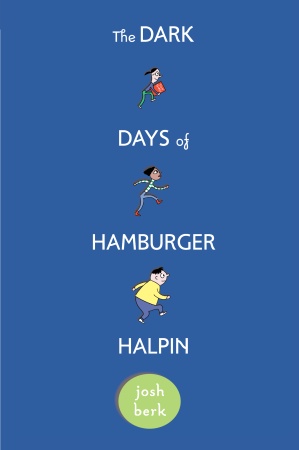
The Dark Days of Hamburger Halpin by
Josh Berk
Reading level: Young Adult
Hardcover: 256 pages
Publisher: Knopf Books for Young Readers (February 9, 2010)
ISBN-10: 0375856994
ISBN-13: 978-0375856990
SP: On your website, you wrote that you had a dream about a kid reading lips on a school bus and that was your inspiration for the book. How did you decide to include a deaf character?
JB: Yes, it literally came from a dream! I just had a short, spooky dream about a kid reading lips on a school bus. It seemed like if he were deaf, and the spookiness came from a mystery, this could be an interesting character and plot to build a book around. I woke up inspired. The idea to write from the point of view of a deaf character just seemed compelling to me as a writerly challenge... Actually before this book I did also write a (never-published, never-even-completed) short story about a deaf guy in a strip club. It's probably a good thing that wasn't published! Anyway, I think that as a writer (probably just as a person) the idea of communication is very interesting to me, and especially the challenges/differences in communication among people. I'm also drawn to outsider stories and I thought that writing as a deaf teenager in a mainstream high school would allow me to say some of the things I had to say about high school and life.
SP: What type of research did you do for the book to make your characters realistic? Your acknowledgments mentions this slightly, would you elaborate about the blog and discussion boards you used?
JB: Of course, after the original idea of "hey it would be neat to write from the point of view of a deaf person," I realized that I had to do a lot of research! I knew
nothing going in, but I'm a librarian by day and I like research. I jumped in and I found the Deaf world fascinating. Like many hearing people, I was painfully clueless about what it's like to use sign language, what the issues are in the Deaf culture, and what reality is like as a deaf person. I ran to the library shelves and read a ton of stuff from memoirs to more academic studies. One of the books I read is by one of your Gallaudet colleagues -- Gina Oliva. Her book,
Alone in the Mainstream: A Deaf Woman Remembers Public School, (
Oliva) taught me a lot. I know that a lot of the stories in that book are from a while ago and that many changes and improvements in the mainstream education experience have happened since then, but I still learned a lot about the feelings Will might have been experiencing through Gina's book. I also got a sense of some of the particular challenges to being a deaf student in a mainstream school. Another book I remember reading is "Reading Between the Lips: A Totally Deaf Man Makes it in the Mainstream" by Lew Golan.
To learn more about the day-to-day life of a modern deaf person, I spent a lot of time reading the message boards on AllDeaf (
www.alldeaf.com). I forget how I became aware of the site -- I think I just stumbled across it. It was a really amazing resource for me -- I felt like I was sneaking into a secret club! I took lots of notes and drew little details and big picture concerns from the people I stalked on there. (I call it "stalking," but you know in the friendly, non-creepy way.) I also found a blog that's not updated anymore called Beethoven's Ears (
www.beethovensears.com). It was the blog of a deaf librarian and I wasn't afraid to write to her because, you know, librarians are always helpful! We corresponded by e-mail for a little while and I had her read parts of the manuscript that I was unsure about. There was also some blog about
Deaf Characters in Adolescent Literature that I looked at sometimes :)
Then once the book was totally complete I had another deaf reader look over the whole thing and he pointed out some errors I had made about how an interpreter works as well as some details about CI that I got wrong. Of course, there are a few errors that made their way into the final pages, and it really bugs me that I wasn't perfect, but most readers have been rather kind. Thankfully :)
SP: You noted that you began researching Deaf Culture. Do you know any deaf people or have you learned American Sign Language? You explain several signs very well throughout the book. It's challenging to write a book around lipreading. I'm sure you've read the statistics about how much can actually be "read" and how Deaf people often miss out on much of the conversation. You sold me when you used "(something, something)". Would you explain your decision to do this? I think it's brilliant considering the acknowledgment that lipreading is challenging is rarely noted in books with deaf characters.
JB: I had a deaf friend when I was very about ten years old. (Yes, he was rather hefty, but that was about all I took from him for Will. I swear!) We lost touch over the years and I didn't actually know any deaf people when I started writing. Since then I've met more than a few! To teach myself a bit of sign language while writing, I mainly used The "ASL Browser" from Michigan State University (
http://aslbrowser.commtechlab.msu.edu/browser.htm). When I was in the very early stages of writing the book I coincidentally saw some students at my library using this site (mainly to teach themselves funny and/or dirty words) so I made note of the site name, then went home and did the same :) Then I added it to my bookmarks. I used it often while writing the book and found it fun as a writer to include poetic description of sign language into the text. I wish I could say that I actually learned to sign, but I really just learned to fake it! Learning for real is still on my to-do list.
I actually read a lot of conflicting information on lipreading. Some sources claimed it was next to impossible to understand what was being said solely by lipreading. But some books like Lew Golan's indicated it was possible to catch most everything. Lew was late-deafened, so that made his story different than Will's, but every author is allowed a bit of poetic license, right? I hope so. The conclusion I reached was that lipreading was possible, yet difficult, inconsistent, and tiring. These were challenges as a writer, but challenges are great fodder for a novel! I enjoyed writing the difficulties Will faced and the clever ways he had to come up with to understand what was being said and to communicate with his classmates, teachers, etc.
For the sake of the story I described Will and Ebony as exceptionally good at lipreading, and they of course have a knack for catching all the important parts (clues and stuff) but I thought it would be honest and interesting to include the words "something something something" at times to show that Will is not getting every single word. My sources led me to believe that no one can lipread every word without context so I tried to be honest to that. I wondered if including "something something" instead of the actual words being spoken the middle of dialogue would be off-putting to readers, but I thought it would help hearing people understand a bit of what it's like...
Oh! Another bit of research I did was to read
Read My Lips, another teen novel starring a deaf character who reads lips which I know you're aware of. There are some good scenes where the main character misses an important word or two and after reading that I felt like maybe I was on the right track with what I was doing with Will. Then I was lucky enough to get to chat with the author --
Teri Brown (
Click link for my July 2008 interview with Teri Brown) She is a hearing person like me, but she has close family members who are deaf and deep ties to the Deaf community. We had a nice phone chat while I was working on revising the book and she was nice enough to talk me through some issues I was confused about. She is very sweet and was a great help to me.
SP: What do you hope that readers will learn or take away from the book? (For me, I think page 234 when Will states, "I push through the crowd. I am not a ghost" defined the character)

JB: There are a lot of young people who feel less-than-worthy or downright invisible for one reason or another. Will's story is rooted in his experience as a deaf teenager, and I hope deaf readers find someone to relate to and I hope hearing readers come away with a bit of understanding of the Deaf world. That said, I also hope that Will's story is somewhat universal. I know I felt invisible for a period of my adolescence. I spent a lot of time trying to fit in with people I didn't fit in with because I was, um, weird. I didn't find happiness until I let go of that concern and embraced myself, found some great other weirdoes.
That's when life got fun. So, yes, I'm largely inspired by the idea of writing fun, funny, and exciting books that make people laugh and are fun to read, but the deeper theme is that no one is worthless. You might feel weird for any number of reasons, but that's cool. You're cool. Be cool with it. ((Left:
adorable prom picture of himself with his then girlfriend/ now wife that I mentioned when I first looked at his website))
SP: What advice would you give to young people who are reading your books for the first time?
JB: I feel like I'm terrible at giving advice! But I'll say this: I think the key to happiness in life whoever you are is being cool with who you are, finding a few like-minded goofballs to befriends with, and not worrying too much about what the rest of the world has to say. To quote that sage Will Halpin:
"I immediately find myself laughing until tears-- literal tears of chubby, wet joy-- run from my eyes. A beautiful moment. Is there anything more sublime than two friends sharing a laugh at the absurdly weird and dangerous world?"*
*Yes, quoting your own book is as much fun as you'd think it would be ;)
SP: Anything you would like to add?
JB: I'd just like to say thank you so much for having me, for your kind words, for your insightful and wonderful questions, and just generally for writing your blog! It's a great service for readers and I'm honored to be on it. I'd also like to invite your readers who have read my book to drop me a line through any of the places listed here:
http://www.joshberkbooks.com/contact.html -- Don't be shy! I'm really not a stalker.

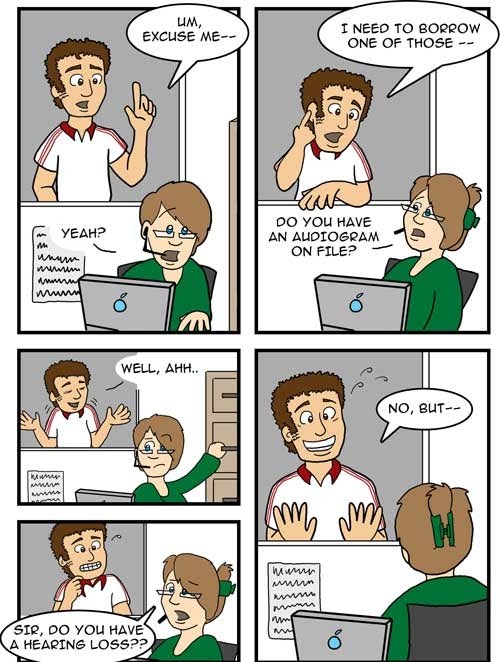
 AC: Becoming a comic author didn't happen overnight. The story of 8 Ways to be Deaf started in January of this year - I had been making comics for quite a while and was tired of being too afraid to try something bigger. So I took the plunge and announced on my blog that I would be doing a full comic book and posting pages 5 days a week. It took several months but as you can see, we survived it. This technique probably isn't for everyone -- I've been working for a long time on my craft. There's still a lot more work left for me to do with improving my skills, but I enjoy learning and telling stories as I go along.
  SP: On your website, you write, "My goal with comics is to make our community’s experiences accessible to the mainstream — visual art is powerful!" What do you hope that readers will learn or take away from the comic books?
  SP: Anything you would like to add?