Monday, July 13, 2009

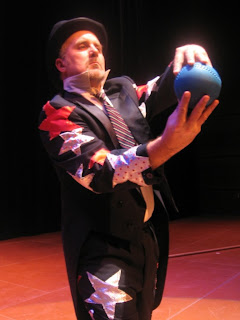
Interview with Deaf Playwright Willy Conley

Playwright and Gallaudet University Professor Willy Conley feature deaf, hard of hearing, and hearing characters created
from the Deaf perspective in his latest work, "Vignettes of the Deaf Character": And Other Plays by Willy Conley Gallaudet University Press; 1st Edition edition (May 15, 2009). His work has also been recently featured in Deaf American Poetry: An Anthology, John Lee Clark, Editor (March 2009).

Because I often believe I am the luckiest girl in the world, I actually met Willy Conley one morning on the Gallaudet shuttle while heading to work. He recognized me from my blog (giggles... how dorky for THE Willy Conley to recognize ME!). I get overly excited when I receive emails from famous people so you can only imagine my excitement sitting next to him. As I always do, I asked for an interview.
************************ Check out my interview with Willy Conley below************************

SPW: Will you explain when you started writing poetry and plays? I read that you noticed how most of the NTID plays were written by hearing people and that was how you became inspired... I'd love for you to elaborate on that.

WC: I believe I wrote my first poem while in college – a sappy, Hallmark-type of poem that I wrote for my mother (who can hear) to send to her on Mother’s Day. It wasn’t until after I took a course in poetry that I began to learn about reading and writing “real” poetry. Real poetry for me involved poems that stimulated my eyes, imagination, and feelings more than my ears. Sure, if I wrote something that rhymed, followed a traditional poetic formula, and sounded cool to the ears, fine by me. But, if I wrote something that was visually or emotionally stunning or provocative, that was a real poem for me.

My first play was written in parts on a big Greyhound bus after I graduated college and was on tour as an actor for three years with the National Theatre of the Deaf. We performed in plays typically written by famous hearing playwrights who originally thought of hearing characters talking in English. If you think that’s an absurd situation for a group of mostly Deaf actors who communicate in American Sign Language – you are right!

As a Deaf actor, it felt artificial to act in a role originally written for a hearing actor from the hearing point of view, no matter how much adaptation was done to get me to fit the mold. After traveling around the U.S. performing in over 500 shows to mostly hearing audiences, I decided it was time to get formal training in playwriting. I then went to graduate school at Boston University to study playwriting. Lucky for me, my teacher, Derek Walcott, won the Nobel Prize for Literature. He is a poet and a playwright. I wanted to be able to write plays with deaf, hard-of-hearing, and hearing characters created from the Deaf perspective. I loved the opportunity to create art with my own characters born out of little sparks of imagination and found pieces of everyday life – this is every playwright’s dream, deaf or hearing. To have that live, moving, three-dimensional art put on stage before an audience would double the thrill. I imagined opportunities for more Deaf theatre companies and university theatres to produce works by Deaf playwrights, which in turn would create more jobs for deaf and hard of hearing people.

SPW: How did you first become published?

WC: In college, I took a course called, Deaf Characters in Literature and Film from the phenomenal, well-known Deaf professor, Dr. Robert F. Panara (you can read about his awesome life and teaching career in:“Teaching from the Heart and Soul”). He taught us how to look for the “Deaf Experience” in the books we read and the films we watched. We would closely examine each to see if a “Deaf Experience” was real or fake to us. Then, he asked us to write an essay about a specific Deaf Experience that we had in our lives. Since I was a Biomedical Photography major at the Rochester Institute of Technology (RIT), I wrote a story about my experience as a medical photography intern called to photograph open-heart surgery, and trying to lipread doctors and nurses who were wearing face masks. Panara gave me an “A” for the paper and encouraged me to submit it to RIT’s literary magazine, Symposium. I followed his advice and notched my very first piece of published writing. It is a very special feeling to see a part of your imagination and/or real-life experience become concrete and real on the pages of a book. It is sort of what the famous diarist once wrote: “We write to taste life twice.”

SPW: I’ve admired Panara’s work for some time now. Tell me what type of research do you do for your plays and your poetry?

WC: Generally, my research involves studying my own feelings about life as well as people from all walks of life -- paying close attention to how they behave, dress, communicate; figuring out what they like or what bothers them. If there is something technical that I need to learn more about -- like the history of bomb shelters -- I go to libraries to read up on them, take notes, and make photocopies, if necessary.

SPW: What do you hope that readers will learn or take away from your work?

WC: That the experience, or imagined experience, that you write about is uniquely yours, whether you’re D/deaf, hard-of-hearing, hearing, male, female, straight, gay, black, white, green or purple – no one can take that away from you.

SPW: What advice would you give to young people who are reading your poems for the first time?

WC: Try to imagine that you are looking at photographs, or watching a movie clip.

********************************************************************************* For more information about Willy Conley or to buy his book, follow this link that describes the book and receive a promotional code to receive 20% off. http://gupress.gallaudet.edu/enewsletters/enewsletter118.html


Monday, June 29, 2009

Documentary about ASL Poetry, "The Heart of the Hydrogen Jukebox"

I met Miriam in 2007 when she put together an evening of film to close the CAID Conference. As a movie buff, she shared her insights into the representations of deaf people in film. I introduced myself to her at the end of the presentation knowing that we had much in common and we have been Facebook friends ever since.
When I interviewed her, she said that she was working on a working on a special project making a documentary about ASL Poetry. Her documentary, The Heart of the Hydrogen Jukebox, includes archival footage of performances and video interviews of deaf poets who experimented with poetic devices in American Sign Language in the 1980's. While some may be witness to great events in history, Miriam was an active participant as a voice interpreter/artist.
I had the privilege of seeing The Heart of the Hydrogen Jukebox at the CAID Conference last Wednesday, June 24. While it wasn't a packed auditorium and the viewing was in direct competition with a Washington Nationals vs. Boston Red Sox Baseball game (as well as exhausted conference participants), the crowd included those who truly valued and appreciated this type of rich documentary.
Lerner explained, "the first part of the film deals with the older style of Deaf poets mostly translating written English works into sign, and then with growing pride in the deaf community and ASL, more experimentation with ASL generated pieces. The second half segues into a time in Rochester, NY, the mid-1980s when Deaf and Hearing poets in this community were privy to each others' works because of the local interpreters' attempts to translate and voice the ASL for the hearing audiences, and translate and sign the spoken poetry, the two communities crossed into each others' realms in a fusion that was unprecedented."
Some of the highlighted poets include Eric Malzkuhn (Malz), Robert Panara, Bernard Bragg, Ella Mae Lentz, Dorothy Miles, Patrick Graybill, Peter Cook, and Debbie Rennie.
When it goes on sale, I highly recommend that you purchase a copy! I laughed, cried, and on more than one occasion put my hand to my heart.


For a taste of ASL poetry, below is the poem, "NEED" created by Deaf poet Peter Cook and hearing poet, Kenny Lerner, Miriam's husband.

Monday, June 15, 2009

Secondary Hard of Hearing Character in Certain Girls

Certain Girls: A Novel by Jennifer Weiner
Paperback: 416 pages
Publisher: Washington Square Press; Reprint edition (April 7, 2009)
ISBN-10: 0743294262
Reading Level: Mature Teens & Adults

Thanks to Julie for recommending this one! "One of the two points of view is a 12-year-old girl who is hard of hearing. She wears hearing aids. Doesn’t sign." Julie also cautions that while this may be a potential cross-over, it is "definitely an adult book" It is a sequel to the book Good in Bed.

From Publishers Weekly
Following the story collection The Guy Not Taken, Weiner turns in a hilarious sequel to her 2001 bestselling first novel, Good in Bed, revisiting the memorable and feisty Candace Cannie Shapiro. Flashing forward 13 years, the novel follows Cannie as she navigates the adolescent rebellion of her about-to-be bat mitzvahed daughter, Joy, and juggles her writing career; her relationship with her physician husband, Peter Krushelevansky; her ongoing weight struggles; and the occasional impasse with Joy's biological father, Bruce Guberman. Joy, whose premature birth resulted in her wearing hearing aids, has her own amusing take on her mother's overinvolvement in her life as the novel, with some contrivance, alternates perspectives. As her bat mitzvah approaches, Joy tries to make contact with her long absent maternal grandfather and seeks more time with Bruce. In addition, unbeknownst to Joy, Peter has expressed a desire to have a baby with Cannie, which means looking for a surrogate mother. Throughout, Weiner offers her signature snappy observations: (good looks function as a get-out-of-everything-free card) and spot-on insights into human nature, with a few twists thrown in for good measure. She expends some energy getting readers up to speed on Good, but readers already involved with Cannie will enjoy this, despite Joy's equally strong voice.


Secondary Deaf Character in Children's Book, Julia's Words

Julia's Words
by Judith L. Roth
Publisher: Herald Press (April 2009)
Language: English
ISBN-10: 0836194179
Main character, Christina meets Julia, a deaf girl, at a campground. As she spends time with Julia, Christina gets a glimpse of what it might be like to be deaf. She also finds out there’s more than one way to communicate, and that friendship is deeper than sound. For children ages 6-10 and their families. Teachers and others who work with deaf children will find this book educational.

Julia is the secondary character who is deaf and uses sign language to communicate.

To read an interview with Judith L. Roth about Julia’s Words, click here.


CODA Characters and other Resources for Deaf Parents with Hearing Children

Thanks to Tom Bull for providing this list of RESOURCES FOR DEAF PARENTS WITH HEARING CHILDREN fact sheet. Also, I have a few other books with CODA characters....

Hardcover: 576 pages
Publisher: Ecco (September 19, 2008)
Edgar uses sign language to communicate. Louise Wilkes is a CODA and communicates using the Sign Language that her Deaf parents taught her. This character works with Deaf children and hearing children of Deaf parents. There is another secondary Deaf Character whom Edgar meets when he is four. The character communicates through Sign Language but also speaks. Edgar notes that he sounds funny (p. 49).

At Face Value (October 2008) by Emily Franklin
Paperback: 264 pages
Publisher: Flux
Linus', a staff writer at the Word, has a father who is deaf. Linus teaches main character Cyrie sign language and the two use it throughout the book.

This book is written by a CODA author......

The Silent Time by Paul Rowe (September 2007)
Publisher: Killick Press.
The deaf character, Dulcie attends the Halifax School for the Deaf in the early 1900s, similar to the author's late mother, Elizabeth Rowe. (This is one of my all-time favorite books!)


Friday, June 05, 2009

Deaf Teen Races on Women's Motorcross circuit

Ashley Fiolek, 18, races as a pro on the Women's Motorcross Association circuit. In the research issue of ESPN The Magazine, you'll find an article about this young Deaf women who is the only woman rider to be featured on the cover of a major U.S. motocross magazine and when Honda Red Bull Racing signed her to its team in January, she became the first American woman with a factory ride.

Hard of Hearing Character in the movie 'Knowing'

In 1959, as part of the dedication ceremony for a new elementary school, a group of students is asked to draw pictures to be stored in a time capsule. But one mysterious girl fills her sheet of paper with rows of apparently random numbers instead. Fifty years later, a new generation of students examines the capsules contents and the girls cryptic message ends up in the hands of young Caleb Koestler. But it is Calebs father, professor John Koestler (Nicolas Cage), who makes the startling discovery that the encoded message predicts with pinpoint accuracy the dates, death tolls and coordinates of every major disaster of the past 50 years. As John further unravels the documents chilling secrets, he realizes the document foretells three additional events the last of which hints at destruction on a global scale and seems to somehow involve John and his son.

Caleb Koestler is hard of hearing and wears a hearing aid. Viewers are told that "sounds get all mixed up for him but the hearing aid helps" and that he is "fluent in sign language". Throughout the movie, the father and son sign that they will be "together forever".
http://www.knowing-themovie.com/

Wednesday, June 03, 2009

Deaf Superhero Wanted

Whether it is to help students improve their reading skills or it is me discussing my favorite superhero, I have posted again and again about Deaf Characters in Comics and Graphic Novels. Thanks to Tracy from Gallaudet for passing this Call for Submissions on to me.


Call for Submissions

If you created the ultimate deaf superhero, what powers would you add? Who or what would the hero be up against? Here's the chance to send in your own comic book pages!

We are assembling an anthology of deaf superheroes. Anyone can submit from 1 to 10 pages of art, in greyscale only. Dimensions are 6 inches by 9 inches (traditional comic book size) and 300 dpi. File formats .gif and .jpg accepted. Collaborations between writers and artists are welcome. The anthology is for all ages, so no extreme imagery or dialogue, please.

DEADLINE IS 1 JULY 2009


Visit http://www.44comics.com for more information!

Sunday, May 24, 2009

Deaf Character in Summer Camp Adventure

Summer Camp Adventure (Keystone Stables) by Marsha Hubler
Reading level: Ages 9-12
Paperback: 144 pages
Publisher: Zonderkidz (October 1, 2009)
ISBN-10: 0310717957


Product Description
For the summer, Skye and her school friend Chad work at special needs Camp Penn’s Woods. Skye runs into a brick wall when she tries to teach Jonathan Martin, a young deaf boy, how to ride Buddy western style, but Jonathan insists on riding him English. When Jonathan and Buddy disappear into the mountains, Skye and Chad lead the rescue to find him.


From the Back Cover
For the summer, Skye and her friend Chad work as teen counselors at special needs Camp Penn’s Woods. Jonathan Martin, one of the campers who is deaf, causes havoc during his riding lessons because he insists on riding English style when Skye tries to teach him western. Skye, who knows American Sign Language, tries to communicate with him, but he is stubborn and refuses her help and friendship. When Jonathan and his assigned mount Buddy, a black gelding, disappear into the hills, Skye and Chad have to lead the rescue to find him.

Friday, May 15, 2009

Marlee Matlin Booksigning

Marlee Matlin will sign copies of her new autobiography, I'll Scream Later, on Saturday, May 16, noon, at Borders, 1801 K Street, NW, Washington, D.C. To read an excerpt of her book, click here.


Note: While Matlin has published books for young adults, this is intended for adults and mature teens.

I'll Scream Later
Hardcover: 336 pages
Publisher: Simon Spotlight Entertainment; First Edition edition (April 14, 2009)
ISBN-10: 1439102856
Product Description
Critically acclaimed and award-winning actress Marlee Matlin reveals the illuminating, moving, and often surprising story of how she defied all expectations to become one of the most prolific and beloved actresses of our time.
Marlee Matlin entered our lives as the deaf pupil turned custodian audiences fell in love with in Children of a Lesser God, a role for which she became the youngest woman ever to win a Best Actress Oscar. More than twenty years after her stunning big screen debut, the Golden Globe- and Emmy-nominated actress is an inspirational force of nature -- a mother, an activist, and a role model for millions of deaf and hard-of-hearing people around the world.
In I'll Scream Later, Marlee takes readers on the frank and touching journey of her life, from the frightening loss of her hearing at eighteen months old to the highs and lows of Hollywood, her battles with addiction, and the unexpected challenges of being thrust into the spotlight as an emissary for the deaf community. She speaks candidly for the first time about the troubles of her youth, the passionate and tumultuous two-year relationship with Oscar winner William Hurt that dovetailed with a stint in rehab, and her subsequent romances with heartthrobs like Rob Lowe, Richard Dean Anderson, and David E. Kelley.
Though she became famous at the age of twenty-one, Marlee struggled all her life to connect with people, fighting against anyone who tried to hold her back. Her own mother often hid behind their communication barrier, and Marlee turned to drugs before she even started high school. However, she found in acting -- with the encouragement of her mentor, Henry Winkler -- a discipline, a drive, and a talent for understanding the human condition that belied her age and her inability to hear. By the time Hollywood embraced her, she had almost no formal training, a fact that caused many other deaf actors to give her the cold shoulder, even as she was looked upon as a spokesperson for their community.
She has played memorable roles on wildly popular television shows such as Seinfeld, The West Wing, and The L Word, danced a show-stopping cha-cha-cha on Dancing with the Stars, and now, with uncompromising honesty and humor, Marlee shares the story of her life -- an enduring tale that is an unforgettable lesson in following your dreams.