Wednesday, February 25, 2009

The International Reading Association Convention, Understanding Diversity in Comics: A Look at Marvel Comics "Echo" & Study Island

The International Reading Association Convention always brings tons of excitement. Last year, I met Myron Uhlberg. This year I met Heather Harper the Managing Editor of Study Island. I can't wait to tell you more about Study Island's Online Graphic Novel Reading Intervention for K-12. The World as You Know is "an original, online graphic novel created by Study Island and its Original Island Inks imprint. It is a three book series following the adventures of Solomon, a Native American middle school student; Lukas, a deaf, foreign exchange student from Cameroon; and Esperanza, an ambitious Hispanic girl who guides Solomon and Lukas on their adventures. The trio believes their world is only as big as their front yard. When the three are shown what awaits them just under the surface of the world they know, they call into question what they know about that world and each other. It is a visual delight mixing one part mystery, one part fantasy, and one part discovery that sends the world on its head." I'm most excited about Lukas Biya. Read his bio below.

Lukas is from Cameroon. He is deaf, which automatically carries its own challenges. However, add to this that he, much like Solomon, is an outcast, and Lukas' life seems even more different than the lives of his classmates. His father is an important diplomat who makes little time for Lukas, but this does little to bring down Lukas and his fiercely independent streak. Lukas is similar to Solomon in that he is a pleasant kid, but he is also very skeptical. These traits are an advantage within the unit of the trio; however, alone, these qualities make Lukas vulnerable to dealing with others. Lukas soon learns that he is the central figure in a situation that is out of his control. It affects his relationships with his friends and family, and just when he thinks that he has come to grips with his place in this world, his world is turned upside down, putting him back at square one. (Study Island)

This will be out in March. I've already seen some of the panels and I'm very excited. I'll keep you posted!

Below is my Poster from the Presentation on Marvel Comics Echo- Deaf, Female and Biracial.

Keep in mind that the International Reading Association does have a Special Interest Group for Deaf and Hard of Hearing Readers. Click on the link for more information.

Sunday, February 08, 2009

Myron Uhlberg comes HOME to Gallaudet University

I have been planning this visit for months and dreaming about it even longer. The week was a whirlwind. First, the book Hands of My Father was selected by Amazon as one of its Best of February selections; then, the book was released; there was a review printed in the Wall Street Journal, and finally Myron Uhlberg, having never stepped foot on Kendall Green, came “Home” to Gallaudet University.
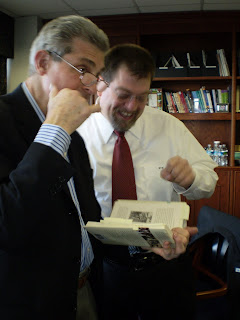
Myron revealed that he was extremely nervous about this visit stating “It’s Gallaudet University. What if Deaf people don’t understand my old rusty sign language”. While he insisted upon interpreters throughout his visit which Gallaudet University provided, I noted presentation after presentation a group of fairly bored interpreters. He walked into each new situation signing without voice. To say that our students loved him would be an understatement. Dr. Bob Weinstock, assistant to the Provost and the man who brought my idea into fruition, called Myron a “veritable rock star.” The freshmen class that he initially visited had created questions for him but once Myron began his story, he did not stop and we had to whisk him off to the next event.
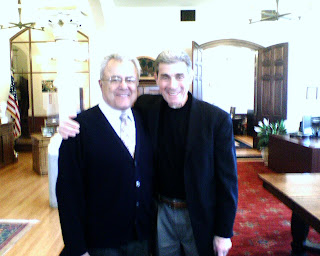
During the luncheon sponsored so graciously by the provost’s office, Myron met faculty and staff members whom I consider to be some of the leading researchers in literature with Deaf Characters. Dr. Cynthia Bailes, librarian Diana Gates, and graduate student Cheryl Shahan were some in attendance. Again, Myron got lost in his story and we had to whisk him away for the campus tour.
For me, the tour given by Ms. Brooke Budzinski, interim coordinator of the Visitors Center was one of the best parts of Myron’s visit. Myron was able to actually see the campus and again and again, he mentioned how beautiful it was and how lovely the people were. Perhaps I overlook our campus’ hospitality on a daily basis but everyone signed greetings to Myron throughout his visit. On the tour, Ms. Budzinski shared numerous facts about the campus and its history; I even learned a thing or two. We entered the President’s Office and Myron was introduced to Dr. Davila who spent nearly fifteen minutes discussing the past. Dr. Davila had known Myron’s father. After that, he considered the entire visit a success since Myron’s father, Lou Uhlberg, was one of the main reasons for this visit. At 75, Myron still very much wants to impress his father with his book and his visit to THE University for the Deaf. He told me that seeing the young people signing on campus reminded him again and again of his parents. His visit with Dr. Davila was not the last time that he would become emotional during his stay.
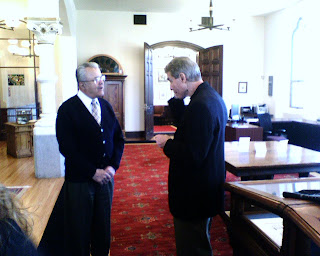
During his visit with Professor Matt Malzkuhn’s class, Myron met a student who was also from Brooklyn. Their regional signs matched and there was no turning back as a newly confident Myron told his story. Although he continually asked for new signs, he refused to change his “old” sign for PICTURE and I’m not even sure if he caught it himself when he mumbled in sign “my father taught me that.” I can’t imagine anyone wanting to change him. Male and female college students hugged him at the end of each meeting; children tugged at his limbs and sat in his lap; grown men cried.
There was only a half hour of down time before his evening presentation. While a few technology glitches were resolved, Myron, who confessed that he just found out that he himself had the proud label of CODA, met a young boy with Deaf parents. Myron, oblivious to the crowd of adults who had come to meet him, stopped everything to make a printer’s hat for the boy who had read his books. He showed the boy exactly how his father had folded each piece. After a dynamic presentation where Myron became the characters in his book and only once used interpreters while he read a short excerpt, I suggested going off campus for dinner. It was around 8pm after an impromptu book signing but Myron wanted to stay on campus to see the students. We dined in the Rathskeller among students and a few faculty members. Myron ate a veggie burger and fries.
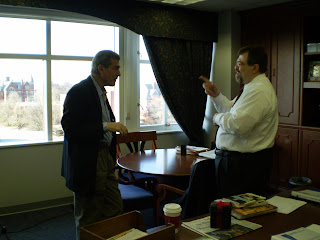
Friday was an early rise. We met for breakfast and with class visits to the students at Kendall and MSSD, Myron already had his newspaper ready. The first stop was a “short” visit to the Provost’s office. Dr. Weiner greeted Myron as a long lost friend. “Call me Steve,” he signed and the two entered the office with possibly the best view of Gallaudet University, if not Washington, D.C. It is impossible to do it justice by documenting the events that occurred during this visit. Dr. Weinstock and I watched two men discuss Brooklyn, their fathers, and while Myron made “Steve” a printer’s hat I believe he channeled one of their fathers. In those moments, men became boys. I don’t think I have ever seen two people so happy nor nostalgic.
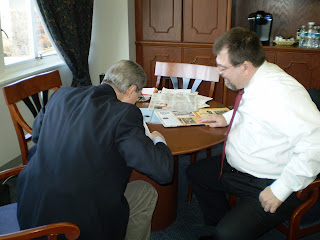
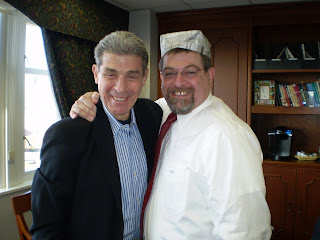
Nearly a half hour late to Ms. Janet Weinstock and Ms. Mary Ann Seremeth’s MSSD class, Myron discussed his books. I was copied on numerous pages reading that we were indeed late but on our way and that from what we have seen Myron Uhlberg would be signing for himself using “Brooklyn Sign Language circa 1940s.” One of my goals of this visit was for others to understand why I loved Myron so much. I did not have to convince anyone once he stepped foot on campus.
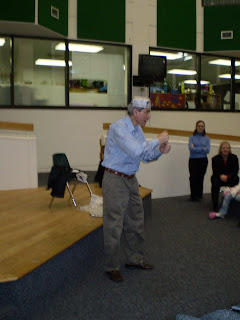
An ardent time keeper, we had one final meet and greet with the children at Kendall Elementary school. An animated Myron teased, made printer’s hats, and showed pictures from his books. It was hard to pull him away from this “presentation” for these were the readers for whom he had written his children’s books.
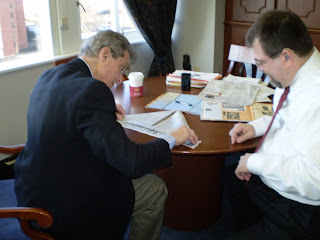
His last and final stop was the Bison Shop where bookstore manager, Ms. Priscilla O'Donnell, had prepared a book signing along with a beautiful display featuring Myron’s books. When Myron does a book signing, he writes short novels not just his name, shakes hands, and listens to others’ stories. I am so honored to be considered his friend and I don’t think I’ve ever been so proud to be part of Team Gallaudet.
His brief visit had ended. In the car he called his wife and said that this was the trip of a lifetime. Gallaudet had stolen his heart just as I believe he had stolen many of ours. While driving up to the Dulles airport, Myron quoted one of my favorite authors. “F. Scott Fitzgerald wrote ‘There are no second acts in American lives’. Fitzgerald was mistaken.” Myron hugged me and with that, I said goodbye to my friend.

Tuesday, February 03, 2009

The Wall Street Journal Review: Between Sound and Silence

Check out: Between Sound and Silence: His parents were deaf. He was not. A memoir By DAVID LODGE

Author Myron Uhlberg Scheduled to Visit Gallaudet University

Daily Digest

Noted author and CODA Myron Uhlberg will read from his new book, Hands of My Father, on Thursday, February 5, 5-7 p.m., in the Sprint Multipurpose Room, I. King Jordan Student Academic Center.

Autographed copies of the book will be available for purchase through special arrangement with the Bison Shop.

Hands of My Father is a critically acclaimed book about the relationship between a hearing child and his deaf parents. The book, to be published on February 3 by Random House, is one of seven "Best of February" selections on amazon.com. Mr. Uhlberg's previous books include the children's classic Dad, Jackie, and Me, which has won 28 awards. Mr. Uhlberg will visit General Studies classes at Gallaudet and elementary and high school classes at the Laurent Clerc National Deaf Education Center during his two-day visit.


The public presentation on February 5 is sponsored by the Office of the Provost and the Program of General Studies.Come one, come all!

Friday, January 30, 2009

Interview with C.F. Brunner, author of Isles of View

Here is the love story of a deaf man and a hearing woman. We've probably all heard the statistics that marriages between deaf and hearing people just don't work out; however, there are also the statistics that marriages (between any groups of people) just don't work out. Characters Dan Brighton and Cara DiSordo share their unique struggles of marriage and communication in a world where even when we speak the same language we have a hard time understanding one another. And then, Cara accepts a position that will take her away from her husband for nearly four months. Will distance make the heart grow fonder?

Isles of View by C. F. Brunner
Paperback: 162 pages
Publisher: iUniverse, Inc. (March 20, 2006)
Reading Level: Crossover to Adult
***Read my interview with author C.F. Brunner below***
SPW: What prompted you to write the story? The book list description reveals that your marriage to a deaf man inspired this work.

CFB: Yes, while I’ve always had the desire to write a novel, being married to a deaf man did inspire this book. People were always asking me what it is like to be married to a deaf person. They wondered how we communicated. For instance, they would ask if we speak in sign language all the time? Or how we were able to talk to each other when it got dark outside and he could not read my lips easily. Some people were curious if our house is quiet all the time with a deaf person living there. So I thought of all the different experiences we had shared, and I began to write them down. Some of the experiences were fun, some surprising and some were even frustrating. But altogether they showed what the hearing and deaf experience is about. Soon I developed a novel from all my notes.

SPW: What type of research did you do for your book?

CFB: The deaf character in my novel and my husband, both attended American School for the Deaf in West Hartford, Connecticut and Gallaudet University in Washington, D.C. I wanted to be sure that I depicted accurate facts regarding both institutions so I did some research on them. Also, the history of sign language in America is intriguing as it was formalized by one man, Thomas Hopkins Gallaudet. I researched this man as well so I could offer interesting and accurate information.
Also, I had learned much from all the years of being with my husband. He is unable to hear, but he has exceptional skills of observation, and in understanding different personality traits in people. This learning experience with him provided me with a real life study for my book.

SPW: You had your character learn some basics of Sign Language? Did you do this yourself? Will you describe your struggle overcoming communication?

CFB: Yes, I learned sign language myself. At the beginning, before I had learned signs, it was somewhat difficult to talk to Don. I had to repeat myself frequently because he didn’t understand what I was saying. Also, I had to make the effort to speak slowly so he could better read my lips. That became cumbersome so I decided to teach myself a few signs. I bought books with illustrations of hand and finger signals for many words in the English language. I started putting them together into sentences and then it became easier to communicate with him.
Still, it is an ongoing process and even after years of knowing each other, communication can at times still be a challenge. It takes patience and understanding. I wouldn’t say that we’ve overcome the struggle to communicate, but we’ve learned how to manage it nicely.

SPW: What do you hope that readers will learn or take away from the book?

CFB: My hope is that readers will learn that even people with different abilities can share love. Often it is just those very differences that make a relationship very special. Obstacles can be overcome when both people are motivated to make everything work.
Additionally, I’d like readers to recognize that not all deaf individuals are the same. They are as unique as we hearing people are. Some deaf individuals prefer sign language to speaking, and some deaf people prefer speaking to sign language. It is their choice based on their own backgrounds and skills. The best thing that hearing people can do for deaf people is to allow them to be themselves. Trying to fit them into a category of an ASL (American Sign Language) user, or an Exact English user or even as an Oral deaf person is not fair or practical. Trends come and go, and the person is still just who he or she is.

SPW: What advice would you give to young people (or the young at heart) who are reading your book for the first time?

CFB: My advice is to be open to differences in people. Not just between hearing and deaf people, but to all people. Kindness and compassion go a long way in this difficult world. It makes others smile, and our hearts can smile with them when we know we’ve given our best.

SPW: Anything you would like to add....

CFB: I think people will enjoy my book. It is a sweet story about two people who find each other, connect and work very hard to stay together. It reflects optimism and compassion. It is a realistic depiction of the deaf and hearing experience of two unique individuals.

Thursday, January 22, 2009

Secondary Deaf Character in Whitethorn Woods by Maeve Binchy

Whitethorn Woods (2007) by Maeve Binchy

I literally found this book on my desk. Thanks to colleague Jane H. for reading this one to the end and then running it up the steps to let me know that she found a Deaf Character! This book is for adults but may be of interest for older teens.

Melanie is the Deaf Character in the story and shows up near the end of the book. Each section is told from a different character's point of view so this is her section. Melanie attended presumably a deaf school called St. Martin's a school "for girls like me"(359). She describes herself as "profoundly deaf" (359) and communicates in "sign language" and speech (363). She enrolls in a training program so that she can later teach deaf children (373).

Book Description
Everything is changing in Rossmore. No longer a sleepy Irish town, where young people leave to travel the world; nowadays it's a prosperous place, so busy that a new bypass has been proposed.
The people of Rossmore are divided, particularly since the road will go right through the Whitethorn Woods and the well dedicated to St Ann. It's a well thought by some to have near spiritual properties and by others dismissed as superstition. No one is more concerned than the honest and well-meaning curate Father Brian Flynn, who has no idea which faction to support. Surely Neddy O'Brien's family should take the compensation being offered for their land? But wasn't Neddy's mother given a cure at the well many years ago? And what about the childless London woman who came to the Whitethorn Woods begging the Saint for help, with the most unexpected consequences? Lifelong friends who first met on an Israeli kibbutz visit the shrine to sort out their marriages; a wealthy American seeks advice; and a murderess and her mother have both considered consulting the saint...


Thursday, January 15, 2009

19 days until Myron Uhlberg's book release.... and his visit to Gallaudet!!!

Hands of My Father: A Hearing Boy, His Deaf Parents, and the Language of Love by Myron Uhlberg will be released on February 3, 2009. I have been mentioning this book for quite some time so I'm thrilled that Myron Uhlberg will be making his way to Gallaudet University for the release of his memoir. During the IRA Convention, I met and instantly adored Mr. Uhlberg. I laughed and cried during his presentation about the legacy of his parents, Sarah and Lou Uhlberg. It was an absolute honor to attend his presentation then as it is to call him "friend" now.
If you're like me and you just can't wait to read the book (luckily I received an advance copy months ago), check out his essay "Language Instincts" provided by Amazon.com.

"Language Instinct"
View SlideShare document or Upload your own.

Wednesday, January 07, 2009

Looking for a Few Good Writers... Will you answer the Call?

Perhaps your New Year's Resolution is to have your great American novel published... or to finally share that poignant poem that you have written. In the past, I have had several aspiring writers contact me regarding their manuscripts and haven't been able to give them any guidance... until now.
If you're a writer and also Deaf or Hard of Hearing, you may want to contact Drs. Nelson and Harmon at Gallaudet University. They have recently made a Call for Submissions (below). The deadline is quickly approaching!
****************************************************************************
We (Jennifer Nelson and Kristen Harmon) have a well-respected press who is interested in working with us on a collection of Deaf American prose (which we define broadly as including, but not limited to:
• short stories,
• flash fiction—and other innovative forms of short fiction—
• non-fiction/memoirs,
• personal essays,
• blogs,
• prose innovations in ASL/English transliteration,
• satire and humor writing, and
• short plays/screenplays, among others.

The subject matter does not have to be explicitly about deaf, Deaf, or hard of hearing American lives, but we do want the author to be deaf, Deaf, or hard of hearing.Please send both of us an email at Kristen.Harmon@gallaudet.edu, and Jennifer.Nelson@gallaudet.edu, to let us know that you are considering submitting prose work. Please send us this work or your proposal as an attachment on or before March 1, 2009. We will respect the confidentiality of your work while it is under consideration.If you know someone who also might be ready to submit work for this collection, please let us know that person’s name and contact information.
*******************************************************************************

Friday, January 02, 2009

Sign Language and Secondary Deaf Character in Oprah's Book Club text, The Story of Edgar Sawtelle

I've hesitated adding this book to my blog because the story is about main character Edgar who is described as "mute". Folks keep bringing this book to my attention and it is one of Oprah's Book Club reads....

Edgar uses sign language to communicate. Louise Wilkes is a CODA and communicates using the Sign Language that her Deaf parents taught her. This character works with Deaf children and hearing children of Deaf parents. There is another secondary Deaf Character whom Edgar meets when he is four. The character communicates through Sign Language but also speaks. Edgar notes that he sounds funny (p. 49).

The Story of Edgar Sawtelle: A Novel by David Wroblewski
Hardcover: 576 pages
Publisher: Ecco (September 19, 2008)

Book Description
Born mute, speaking only in sign, Edgar Sawtelle leads an idyllic life with his parents on their farm in remote northern Wisconsin. For generations, the Sawtelles have raised and trained a fictional breed of dog whose thoughtful companionship is epitomized by Almondine, Edgar's lifelong friend and ally. But with the unexpected return of Claude, Edgar's paternal uncle, turmoil consumes the Sawtelles' once peaceful home. When Edgar's father dies suddenly, Claude insinuates himself into the life of the farm--and into Edgar's mother's affections.
Grief-stricken and bewildered, Edgar tries to prove Claude played a role in his father's death, but his plan backfires--spectacularly. Forced to flee into the vast wilderness lying beyond the farm, Edgar comes of age in the wild, fighting for his survival and that of the three yearling dogs who follow him. But his need to face his father's murderer and his devotion to the Sawtelle dogs turn Edgar ever homeward.

Tuesday, December 30, 2008

Children's Book: It's Called Deafness

"It's Called Deafness"
I Am Deaf (Live and Learn Series) by Jennifer Moore-Mallinos (Author), Marta Fabrega (Illustrator)
Reading level: Ages 4-8
Paperback: 32 pages
Publisher: Barron's Educational Series (March 1, 2009)


Product Description


Titles in the Live and Learn series take a child’s point of view--especially the view of children who either suffer from some physical challenge or lack self-confidence in going about their everyday activities. This book describes challenges that hearing-impaired children face, and how one child overcomes them to live a normal, happy life. This attractively illustrated picture storybook series encourages kids to understand themselves and overcome problems that have troubled them. Following each story are four pages of suggested activities that relate to the book’s theme. A final two-page section offers advice to parents. Live and Learn titles are available in both English and Spanish language editions. This is an English language title.

SPW Note: The title is listed as I Am Deaf but the picture on the book calls it It's Called Deafness. Not sure which one is correct... Seems a little confusing to me.