Thursday, April 14, 2011

New YA Book with a Signing Deaf Character-- out in 5 Days!

It's important to know that I'm not dead just because I haven't posted on my blog since... eeek, January? Really? Yikes. It has been an extremely busy semester. I have two books that I need to write blurbs about and an author interview waiting and...and...there are three weeks left to this semester and everyone is under a great deal of pressure!
Speaking of pressure, the same can be said for this author who in 5 days will have her book released to the masses.  I haven't read the book yet but it looks pretty interesting. She has already published one novel, BREAK, which was included on the ALA's 2010 list of Popular Paperbacks for Young Adults. Hannah (the author... I can call her that because YA authors are cool like that!) wrote me and said that the main character's youngest brother is Deaf and uses "ASL" with his family members. Hannah also happen to mention that she took some ASL classes at Gallaudet. As soon as I read the book, I'll interview her and find out all of her secrets. For now, check out the author's AMAZON page and look for her book soon.  

Invincible Summer by Hannah Moskowitz
Reading level: Young Adult
Paperback: 288 pages
Publisher: Simon Pulse; Original edition (April 19, 2011)
ISBN-10: 1442407514

Product Description
Noah’s happier than I’ve seen him in months. So I’d be an awful brother to get in the way of that. It’s not like I have some relationship with Melinda. It was just a kiss. Am I going to ruin Noah’s happiness because of a kiss?
Across four sun-kissed, drama-drenched summers at his family’s beach house, Chase is falling in love, falling in lust, and trying to keep his life from falling apart. But some girls are addictive....

Tuesday, January 04, 2011

On the Odd Hours

On the Odd Hours (Louvre Collection), Eric Liberge
Reading level: Ages 9-12

Paperback: 71 pages
Publisher: ComicsLit (April 2010)
ISBN-10: 1561635774

Bastien is deaf and uses sign language to communicate.
From Booklist
Like Nicolas Crecy’s Glacial Period (2007) and Marc-Antoine Mathieu’s The Museum Vaults (2008), the third Louvre-sponsored graphic novel is a fantasy, though set in the present, not the future. A guard accosts burly young Bastien—head shaved except for a forelock and goatee—eating within the hallowed gallery. Conveying that he is deaf, Bastien scribbles a note explaining he has an appointment there. Humiliated, he stomps off before his story’s fully checked. But a wizened Chinese man signs to him. The old man, a guard himself and also deaf, is the person Bastien had to meet all along. He expects Bastien to succeed him in watching over the souls of the artworks, which escape canvas, stone, and metal during the odd hours of deep night. Despite misgivings and his girlfriend’s overbearing caretaking, Bastien decides the job’s the perfect fit for him. Virtuosically rendered by Liberge, who merges elegant clear-line figuration, expressionistic pastel coloration, and in the odd-hours sequences, superimposition effects, Bastien’s story powerfully expresses the frustrations of deep hearing impairment and the irrepressible life of great art. --Ray Olson

Broken Voices

I just came across this book today and look forward to reading it. Be sure to visit the author's website.

Broken Voices, Winona Rasheed
Reading level: Young Adult
Paperback: 68 pages
Publisher: New Line Press (June 23, 2010)
ISBN-10: 1892851326

Main character Ella uses sign language and speaks to communicate
Product Description
Moving from one city to another as a freshmen student attending a new high school has its qualms. However, the situation becomes even more difficult and intense when the new student has a secret that she tries to hide from her classmates. 13-year-old Ella Rose from Savannah Georgia appears to be normal at one glance, until she speaks or tries to communicate. Unlike everyone else at Manchester High School in Washington DC, Ella Rose Abbot is different, and it will take more than the standard school uniform to make her feel that she fits in and belongs with the rest of the students, despite her secret. However, as Ella finds out, some situations are not easily hidden, turning one small bad situation into a mountain of chaotic problems as you try to hide the obvious. Broken Voices is an encouraging story that takes you inside a different world, the world of the handicapped and people with broken voices and impaired hearing. Editorial Review: "Ella Rose Abbot begins her first day of high school full of self-doubt and then triumphs over the day. Ella, a deaf girl, signs, writes, and speaks with "a broken voice," as it turns out, very beautifully. "Broken Voices" is a story that will lift you up and make you feel better about the world." --Kris Harpster

Thursday, November 11, 2010

FIVE FLAVORS OF DUMB interview with Deaf Character author ANTONY JOHN

Five Flavors of Dumb (TODAY November 11, 2010), Antony John Reading level: Ages 12 & Up
Publisher: Dial

This semester I’m teaching an overload schedule. Between my course load, my other duties as a faculty member, and buying (or rather building) a house, writing that this semester has been hectic would be an understatement. Today there was an Open House at Gallaudet University. In Fictional Deaf Characters in Adolescent Literature World, I’m pretty sure Antony John’s main character, Piper from Five Flavors of Dumb was there.
When I first wrote Antony John in December 2008 about his novel, he responded, "Incidentally, the narrator's motivation for managing her high school rock band is that she plans to attend Gallaudet and her parents have just blown her entire college fund. I guess this means you'd be her professor!"
I can’t wait to teach Piper. She’s a little bit snarky (let me just tell you how pleased I am that Antony John even used that term in his novel). She isn’t that over-the-top sarcastic that you find in some novels for teens but she has just enough teen angst to make her believable. In fact, having a Deaf Character (Piper is majorly Hard-of-Hearing with hearing aids that desperately need to be replaced because she has had them forever!) as the manager of a rock band actually makes a great deal of sense, especially this semester. Gallaudet’s New Signers program has grown. My first year student courses include students one might assume would be at Gallaudet—Culturally Deaf individuals who attended schools for the Deaf. My classes also include numerous “signing” deaf students who attended mainstream programs, and now several deaf students who attended oral programs. College is a time of major transitions and watching these New Signers navigate their experiences at Gallaudet is awe-inspiring.
Piper, however, is already fluent in sign language. Her mother is a CODA. She has a younger brother, Finn, who can sign fluently although he’s a bit embarrassed to do so in public. Piper’s father has never bothered to learn the language. As a Senior in high school, Piper is already preparing to attend Gallaudet University (presumably in Fall 2011) with the savings her Deaf grandparents left her while she too prepares for the changes ahead. Unfortunately, she’s already dealing with changes at home. There’s her new baby sister Grace who is also Deaf. When Piper’s parents decide that a Cochlear Implant is the best thing for Grace, Piper is left feeling very much alone and missing her late grandparents who “would have never let that happen” (44). Piper also had to deal with the changes of her best friend and only person who ever “got” her, Marissa moving away. While they hoped to video chat nightly on their computers, this stopped when Marissa’s camera on her laptop stopped working (32). There’s her friend, Ed, who is the fun-loving, chess-playing, informed-about-Deaf-Culture, super geek friend who ends up joining Piper’s biggest change and her last hope of earning enough money to attend Gallaudet after her parents blow her money on… well, you’ll just have to read the book—the band DUMB! Piper will tell you that “for the record, [she] wasn’t around the day they decided to become Dumb” (1) but she is the band’s main hope of a lasting, and hopefully financial future.
Needless to say, I’m very excited to introduce you to Piper… and of course, there is the man who created her Antony John. Read my interview with him below!
******************************************************************************************

SP: What was your inspiration for Piper?
AJ: You know the saying: “Write what you know”? Well, it’s not really the best advice, to be honest. See, I used to be a professional musician, so I figured I’d write a book about music. But there are lots of YA books about music and rock bands already. Plus, the joy of writing isn’t really rehashing what you already know, but getting inside the head of someone you most definitely do NOT know, and hearing music through her ears. So I asked my wife for advice, and the first thing she said was: “Piper’s deaf.”
As soon as she said it, I got crazy excited. I just knew this was the book I had to write. Music has always been integral to my life, something that affects me deeply, and I couldn’t resist the chance to explore it from another perspective entirely. I knew of professional musicians like percussionist Evelyn Glennie and rapper Sean Forbes who are deaf, but I wasn’t completely aware of how they heard/felt music, and the particular challenges they faced. Piper allowed me to explore all that.

SP: What type of research did you do for the book to make your characters realistic?
AJ: Remember that “crazy excited” feeling I just mentioned? Yeah, well, that wore off pretty quickly when I started doing research. I’m ashamed to admit this, but I knew next to nothing about deafness, and had no idea how complicated it is, both from a physiological and a social perspective. But I still knew I had to write the book, so . . .
I began by talking to audiologists about the various causes of deafness, the technology involved in hearing aids, how a cochlear implant works, etc. Then there were movies and documentaries and books and YA novels about deafness and the experience of growing up deaf.
But above all, I enlisted the help of a couple of deaf readers—Tadd Simmons and Valerie Bu—who critiqued the book in an early draft. I asked them to take issue with everything that didn’t ring true, and they took me at my word. I’m enormously grateful to them for contributing some of the details that make the book feel real to me.
I’d heard of Gallaudet University before I began writing. Since Piper is a really smart student, I wanted the dream of attending Gallaudet to be the thing that helps her endure high school. When her parents raid her college fund, the dream is put in jeopardy, and the rest of the book is set in motion.
Incidentally, the situation depicted in the book—the cessation of deaf programs in Piper’s school—is actually quite real. It happened to a local school as I was leaving Seattle in 2008. It affected a lot of families.

SP: Have you learned American Sign Language?
AJ: No. I attended an ASL class, and watched DVDs and studied books, but I only know a very few signs. I’d love to sign as fluently as Piper and her mom and brother do, but for the purposes of the book, the more important issue was for me to empathize with Piper’s father and Ed as they attempt to learn ASL. I wanted to know what signing felt like, physically, and how self-conscious hearing people become during their first faltering attempts to sign.
Fortunately, I was welcomed along to the ASL class at Concordia Seminary in St. Louis, where the students were really open to talking about the experience of learning ASL.

SP: What do you hope that readers will learn or take away from the book?
AJ: I was determined that FIVE FLAVORS OF DUMB would not be an issue book; partly because I wasn’t interested in writing such a book, and also because I’m not the right person to do it. I’ve done enough research to know how little I really know about deafness.
That being said, I think there’s real value to a book featuring a protagonist (especially a narrator) who faces challenges that many readers will never experience. The questions I’ve received from readers of the Advanced Copy have really rammed home to me how little most people understand deafness. If this book helps to clarify things—even just a little—then so much the better.
In a more general sense, the main thing I’d like readers (especially teen readers) to take away from the book is that communication is key. Everyone in the band has issues saying what they mean. (Even Josh, the egotistical lead singer doesn’t tell things like they are.) Only when they all start talking and listening do they overcome these issues and start to gel.
I am constantly amazed at how useless adults are at such a basic skill as communication. (I include myself here, for the record.) So I really wanted to send the message: say what you think; be direct; be confident; and respect others for doing the same.

SP: What advice would you give to young people who are reading your books for the first time?
AJ: Although you shouldn’t judge a book by its cover, FIVE FLAVORS OF DUMB is the exception. The book is supposed to be funny, and chaotic, and full of rock music. All the same, more than one reviewer has likened it to Sarah Dessen’s novels, and I think that’s because I really wanted readers to care about the characters beyond their roles as band members.
I admit it: I’m a sucker for true love, happy endings, and a bit of tear-jerking every now and again. Those are the books I love, and that’s the book I set out to write. I hope I’ve succeeded!
Now, a warning: there are no vampires, werewolves, or gratuitous violence in DUMB. It is not part of an eight-book series, and no one has a magic power. Unless being seriously cool is a magic power, in which case Piper, the main character, is truly magical.
Thanks so much for having me along, Sharon. And please tell your readers that I’d love to get feedback from anyone who has read the book. Here’s my contact info:http://www.antonyjohn.net/ antony[at]antonyjohn[dot]net

Tuesday, October 26, 2010

New Deaf Character Book for November


Five Flavors of Dumb (This title will be released on November 11, 2010), Antony John Reading level: Ages 12 & Up
Publisher: Dial

THE CHALLENGE: Piper has one month to get a paying gig for Dumb—the hottest new rock band in school.
THE DEAL: If she does it, she'll become manager of the band and get her share of the profits, which she desperately needs since her parents raided her college fund.
THE CATCH: Managing one egomaniacal pretty boy, one talentless piece of eye candy, one crush, one silent rocker, and one angry girl who is ready to beat her up. And doing it all when she's deaf. With growing self-confidence, an unexpected romance, and a new understanding of her family's decision to buy a cochlear implant for her deaf baby sister, Piper just may discover her own inner rock star.


Saturday, August 21, 2010

New Book: Return of the Lion People by Michael Milone

Return of the Lion People by Michael Milone
ISBN: 978-1-57128-563-8
Readability Level: 7th Grade
Recommended Ages: 12-18+
Subject/Genre: fiction / prehistory


The Deaf Character is introduced in the second chapter.

Arena Press announces The Return of the Lion People, the second book in the Nasha series.
            The Wolf Clan faces a terrifying enemy in the second installation of Michael Milone’s Nasha series. The Lion People, a marauding clan that had disappeared for a generation, returned and continued their violent ways. Despite the valiant efforts of defenders, the warriors of the Lion People kidnap many of the Wolf Clan’s women and children. Given their almost impenetrable lair, the Lion People have little fear of a rescue attempt. Moreover, as a peaceful tribe, the Wolf People have little chance against such a formidable enemy.
            Available at bookstores and online through amazon.com and other distributors, Lion People shows the contrast between a hunter-gatherer clan and a warrior clan in the same region. “Humans have adapted in many ways,” says Dr. Michael Milone, a research psychologist. “Our family tree has many branches, from peaceful clans who spent most of their time developing survival skills to aggressive groups that preyed on others.”
            Some new characters are included in this sequel, including a remarkably resilient and capable deaf woman and her two daughters. In addition, the blind storyteller, Checo, shows a surprisingly contemporary ability that young readers will enjoy learning about.
            “It has long been assumed that ancient humans simply abandoned children with disabilities or they perished from natural events. I find this difficult to accept because humans 15,000 years ago were so much like us today,” admits Milone. “The notion of abandoning a child would be impossible for most of us, and I have no doubt that many disabled young people survived to adulthood and contributed to the society in which they lived.”
            As was true in Nasha: The First Dog, the wolves are not harmed in Lion People, and they contribute in a unique way to the climax. Some of the clan members are not so lucky and die while attempting to defend the village. “I wanted to introduce young readers to the practice of treating the dead with respect, a practice that is as old as humans themselves. I agree with the British statesman William Gladstone that a society can be measured by the manner in which it treats its dead, and I think young readers will appreciate not only the ceremonial burial, but also the discussion that follows.”
            The focus of this work is more on the humans than the wolves, a departure from the first book in the series. “Although the wolves play an important role in the story, it is more about how the members of the Wolf Clan interact with one another and other clans as well as respond to an enormous threat from the Lion People. A high level of action is maintained throughout the book, and more of the discoveries of humans are introduced. As was true with the first book, the underlying message is that humans fifteen thousand years ago were intelligent, persevering, and caring people. Our human journey is a remarkable story, and I hope that young readers will feel a sense of pride in what our ancestors accomplished.”
            The lives of humans have been enriched for a thousand generations because of our association with dogs, and nowhere is the genesis of this relationship told more eloquently than in the first book in the series, Nasha: The First Dog. A determined girl adopts an abandoned wolf pup. This simple act of kindness changes the life of her clan. Nasha, as she names the wolf, is the catalyst for some of the discoveries that the members of the clan make, discoveries that in the millennia to come will form the foundation of civilization.

Michael Milone, Ph.D., is a nationally recognized research psychologist and award-winning educational writer who began his career as a teacher in general and special education. He earned a Ph. D. in 1978 from The Ohio State University, holds a Master of Arts degree from Gallaudet University, and is fluent in American Sign Language. He lives in New Mexico with his wife, Sheri, and a houseful of dogs and cats. He has completed more than thirty marathons and two Ironman races, although he confesses that his knees are reluctant to continue with such madness. Dr. Milone is available for interviews and select personal appearances. He may be reached at 505-867-0276 or MMilone@aol.com.
Arena Press is an imprint of Academic Therapy Publications. For more information about both companies, please visit our Web site at academictherapy.com. For more information about this book, visit nashathefirstdog.com.

  Click Here to purchase book through the publisher's website

New Book: Secret Signs by T.J. Waters (November 2010)

Secret Signs by T.J. Waters
Paperback: 256 pages
Publisher: Gallaudet University Press; 1st Edition edition (November 30, 2010)


SYNOPSIS:
Amy Kellen has a new job as a sign language interpreter for All Hands Video Relay Service (VRS), enabling routine telephone calls between the deaf and hearing communities. When a political strategist dies during a video call Amy discovers she was not an observer, but rather the unwitting trigger of a political assassination. Can she save herself, her daughter, and her code of silence when the assassins come for her?

Sunday, July 25, 2010

New comic book *8 Ways to be Deaf* and interview with Deaf Author Adrean Clark

I am VERY excited about this new comic book 8 Ways to be Deaf by Adrean Clark. The author/artist describes 8 Ways to be Deaf as "the story of a gas station attendant who meets a Deaf woman and takes extraordinary measures to win her. His only problem -- he's his own worst enemy". And, it is FUNNY! If you know me, I laugh a great deal but usually at myself... rarely do I laugh out loud when reading anything. Half way through this comic, I almost stopped to email Adrean because it was that funny. That being said, I am thrilled to introduce readers, young and old, to this story of a hearing guy Paul who goes through numerous attempts to win the heart of Deaf Character Linda. And not to give away too much of the plot but the ASL instructor Ms. Peterson and the interpreter are both hysterical... but maybe that's just because that's how I felt when I learned ASL. I believe this comic is appropriate for middle school up based on content and reading level; however, it will resonate with anyone who has tried to win the affection of another.


Another exciting thing about 8 Ways to be Deaf is that you can buy it online through an eBook download for as cheap as $1.99; however, if you'd rather hold the comic in your hand (and not just on your iPad), a print edition will be available in August.
****************Read my interview with Adrean Clark below**************
SP: How did you become a comic book author?
AC: Becoming a comic author didn't happen overnight. The story of 8 Ways to be Deaf started in January of this year - I had been making comics for quite a while and was tired of being too afraid to try something bigger. So I took the plunge and announced on my blog that I would be doing a full comic book and posting pages 5 days a week. It took several months but as you can see, we survived it. This technique probably isn't for everyone -- I've been working for a long time on my craft. There's still a lot more work left for me to do with improving my skills, but I enjoy learning and telling stories as I go along.
SP: What inspired you to write 8 Ways to be Deaf? Do you know anyone like Paul? Or perhaps, have you experienced what Linda experienced?
AC: 8 Ways to be Deaf actually started as an orphan title. My DeafBlind husband and I own Clerc Scar, a publishing company, and 8 Ways to be Deaf was a potential title for one of our books. Even after it was rejected it had too much promise to be abandoned and the story of a bumbling hearing man trying to be Deaf came to mind. Comic ideas can come in strange ways!
I came to ASL and Deaf Culture later in my childhood. I can remember wanting very badly to fit in with my new Deaf friends after transferring to the Central North Carolina School for the Deaf in eighth grade. I wanted ASL to drip from my awkward hands, so I could measure up to them. It took a long time before I felt confident in my signing skills. I can identify with Paul in that way.
On the other side of the counter, I've also been accosted by well-meaning hearing people. Those encounters tend to be awkward and ones I try to escape as quickly as possible. Linda probably has more courage than I do, returning to the same gas station as part of her morning routine!SP: On your website, you write, "My goal with comics is to make our community’s experiences accessible to the mainstream — visual art is powerful!" What do you hope that readers will learn or take away from the comic books?
AC: My husband John is also a writer (author of Deaf American Poetry at GU Press), and he says he keeps no expectations for the reader. I agree, but I do hope readers come away with an idea of how it feels on both sides of the gas-station counter. I hope that chuckling at Paul's misadventures will help hearing people see that approaching Deaf people with a respect for their culture and language is important, no matter what mistakes are made. The point is to keep trying and improving. Who knows what that will bring?
SP: What advice would you give to young people who are reading your comics or creating their own for the first time?
AC: My advice for young aspiring artists is to keep drawing. Making comics is hard work, and if it's something you truly enjoy and feel energized by -- you will work through all the frustrations and joys it brings. There's a saying that for every awesome drawing there's 10,000 lousy drawings. It's not so hard if you had fun doing it all.
School won't teach you that, it comes from within yourself. Think of classes as one resource out of many for your goal, and take advantage of that. Don't be afraid to keep learning in as many ways as you can - through books, experienced pros, and so on. This applies to any career, not just comics.SP: Anything you would like to add?
AC: 8 Ways to be Deaf is not my only book. I also have another book, The Census Taker and Other Deaf Humor. It's actually all text with no funny pictures, but a good read, I hope! Both 8 Ways and The Census Taker are available at http://8ways.adreanaline.com and in the Apple iBookstore. (Please do leave a review, I appreciate all feedback!)
Some other Deaf cartoonists you all might enjoy are Matt Daigle, Shawn Richardson, Maureen Klusza, Kendra Harness, Dan McClintock, and Paul Guo. Their work appears in SIGNews and in the Deaf Cartoonists Showcase book at my website. http://www.adreanaline.com/blog/archive/free-comic-book-day/

Thursday, July 22, 2010

Interview with Josh Berk, author of my new favorite book, The Dark Days of Hamburger Halpin

It took me forever to pick up this book. In May, I mentioned that I knew I was behind because this book was published in February! I'll be honest, I was hesitant to read Josh Berk's book because although I had seen here and there (Facebook status updates, posts from peers, etc) that it was a GREAT book, there was always a mention or two that there were errors about deafness. No one really elaborated on that point but I always read the comments as one that I would not fall head over heels for considering, um, I write a Deaf Character blog. Plus, the word Hamburger in the title didn't interest me as a vegetarian. I know, I know... that is ridiculous but I'm trying to explain why it took me so long to get to this book.

On July 1, I admitted that I had a new professional crush (and maybe a slight crush on the man because I actually think Josh Berk and I would be friends... considering he is a self-proclaimed 'weirdo'). Even more than my crush on author-man Josh Berk is my BIG FAT CRUSH on Deaf Character Will Halpin! In fact, Berk's book is one of my new favorites.

So let me tackle as few of the misconceptions (I did tell the author that I was going to need to address some of the complaints from Deaf readers about mistakes in the book.
  1. There is no past tense in ASL (41). I guess it depends on what you mean by past tense... Will seems to believe that everything happens in the present. That's pretty 'adolescent' of him because after all, young adults live in the NOW; however, as an English professor in Deaf Education, there is a past tense.
  2. "[A teacher] flips the lights on and off, a weird move that is presumably supposed to make us calm down" (57). Every Deaf Education classroom I've been in flicks the lights. Since Will has been at a residential school for the Deaf, he should know this... but he is a sarcastic character and I'm not sure if my students have ever 'calmed down' per se when I've done that. In fact, they usually don't even pay attention [Note to my students: You KNOW who I'm talking about... insert evil eye]
  3. Will's use of his interpreter (126). It's really the interpreters out there who would have a problem with the interpreter's (character Melody) response. Will is a teen so he's going to flirt.
Here's my argument  1)Fitzgerald's The Great Gatsby is filled with errors... and it's still a Classic! I think we need to overlook some errors because the book is THAT good... plus, in my interview with Josh Berk, he explains his research. He asked Deaf people.. and one Deaf person's response isn't universal. There are variations in experience; and, 2) Will is a young adult and he's our narrator. He honestly might not know.

There are so many aspects of the book that I like. I don't want to give it away but some characters know fingerspelling and someone has a Deaf relative and knows ASL (but that's all I can write without giving a way a plot point). I could go on and on.
*************Just buy the book! And, read my interview with the very funny and cool Josh Berk below***********

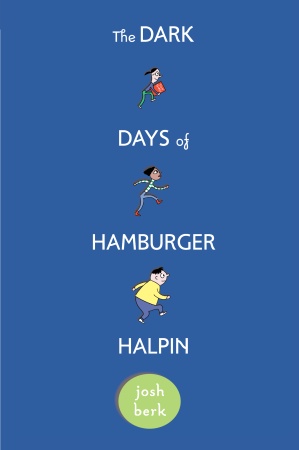
The Dark Days of Hamburger Halpin by Josh Berk
Reading level: Young Adult
Hardcover: 256 pages
Publisher: Knopf Books for Young Readers (February 9, 2010)
ISBN-10: 0375856994
ISBN-13: 978-0375856990

SP: On your website, you wrote that you had a dream about a kid reading lips on a school bus and that was your inspiration for the book. How did you decide to include a deaf character?

JB: Yes, it literally came from a dream! I just had a short, spooky dream about a kid reading lips on a school bus. It seemed like if he were deaf, and the spookiness came from a mystery, this could be an interesting character and plot to build a book around. I woke up inspired. The idea to write from the point of view of a deaf character just seemed compelling to me as a writerly challenge... Actually before this book I did also write a (never-published, never-even-completed) short story about a deaf guy in a strip club. It's probably a good thing that wasn't published! Anyway, I think that as a writer (probably just as a person) the idea of communication is very interesting to me, and especially the challenges/differences in communication among people. I'm also drawn to outsider stories and I thought that writing as a deaf teenager in a mainstream high school would allow me to say some of the things I had to say about high school and life.

SP: What type of research did you do for the book to make your characters realistic? Your acknowledgments mentions this slightly, would you elaborate about the blog and discussion boards you used?

JB: Of course, after the original idea of "hey it would be neat to write from the point of view of a deaf person," I realized that I had to do a lot of research! I knew nothing going in, but I'm a librarian by day and I like research. I jumped in and I found the Deaf world fascinating. Like many hearing people, I was painfully clueless about what it's like to use sign language, what the issues are in the Deaf culture, and what reality is like as a deaf person. I ran to the library shelves and read a ton of stuff from memoirs to more academic studies. One of the books I read is by one of your Gallaudet colleagues -- Gina Oliva. Her book, Alone in the Mainstream: A Deaf Woman Remembers Public School, (Oliva) taught me a lot. I know that a lot of the stories in that book are from a while ago and that many changes and improvements in the mainstream education experience have happened since then, but I still learned a lot about the feelings Will might have been experiencing through Gina's book. I also got a sense of some of the particular challenges to being a deaf student in a mainstream school. Another book I remember reading is "Reading Between the Lips: A Totally Deaf Man Makes it in the Mainstream" by Lew Golan.
To learn more about the day-to-day life of a modern deaf person, I spent a lot of time reading the message boards on AllDeaf (www.alldeaf.com). I forget how I became aware of the site -- I think I just stumbled across it. It was a really amazing resource for me -- I felt like I was sneaking into a secret club! I took lots of notes and drew little details and big picture concerns from the people I stalked on there. (I call it "stalking," but you know in the friendly, non-creepy way.) I also found a blog that's not updated anymore called Beethoven's Ears (www.beethovensears.com). It was the blog of a deaf librarian and I wasn't afraid to write to her because, you know, librarians are always helpful! We corresponded by e-mail for a little while and I had her read parts of the manuscript that I was unsure about. There was also some blog about Deaf Characters in Adolescent Literature that I looked at sometimes :)

Then once the book was totally complete I had another deaf reader look over the whole thing and he pointed out some errors I had made about how an interpreter works as well as some details about CI that I got wrong. Of course, there are a few errors that made their way into the final pages, and it really bugs me that I wasn't perfect, but most readers have been rather kind. Thankfully :)

SP: You noted that you began researching Deaf Culture. Do you know any deaf people or have you learned American Sign Language? You explain several signs very well throughout the book. It's challenging to write a book around lipreading. I'm sure you've read the statistics about how much can actually be "read" and how Deaf people often miss out on much of the conversation. You sold me when you used "(something, something)". Would you explain your decision to do this? I think it's brilliant considering the acknowledgment that lipreading is challenging is rarely noted in books with deaf characters.

JB: I had a deaf friend when I was very about ten years old. (Yes, he was rather hefty, but that was about all I took from him for Will. I swear!) We lost touch over the years and I didn't actually know any deaf people when I started writing. Since then I've met more than a few! To teach myself a bit of sign language while writing, I mainly used The "ASL Browser" from Michigan State University (http://aslbrowser.commtechlab.msu.edu/browser.htm). When I was in the very early stages of writing the book I coincidentally saw some students at my library using this site (mainly to teach themselves funny and/or dirty words) so I made note of the site name, then went home and did the same :) Then I added it to my bookmarks. I used it often while writing the book and found it fun as a writer to include poetic description of sign language into the text. I wish I could say that I actually learned to sign, but I really just learned to fake it! Learning for real is still on my to-do list.

I actually read a lot of conflicting information on lipreading. Some sources claimed it was next to impossible to understand what was being said solely by lipreading. But some books like Lew Golan's indicated it was possible to catch most everything. Lew was late-deafened, so that made his story different than Will's, but every author is allowed a bit of poetic license, right? I hope so. The conclusion I reached was that lipreading was possible, yet difficult, inconsistent, and tiring. These were challenges as a writer, but challenges are great fodder for a novel! I enjoyed writing the difficulties Will faced and the clever ways he had to come up with to understand what was being said and to communicate with his classmates, teachers, etc. 

For the sake of the story I described Will and Ebony as exceptionally good at lipreading, and they of course have a knack for catching all the important parts (clues and stuff) but I thought it would be honest and interesting to include the words "something something something" at times to show that Will is not getting every single word. My sources led me to believe that no one can lipread every word without context so I tried to be honest to that. I wondered if including "something something" instead of the actual words being spoken the middle of dialogue would be off-putting to readers, but I thought it would help hearing people understand a bit of what it's like...

Oh! Another bit of research I did was to read Read My Lips, another teen novel starring a deaf character who reads lips which I know you're aware of. There are some good scenes where the main character misses an important word or two and after reading that I felt like maybe I was on the right track with what I was doing with Will. Then I was lucky enough to get to chat with the author -- Teri Brown (Click link for my July 2008 interview with Teri Brown) She is a hearing person like me, but she has close family members who are deaf and deep ties to the Deaf community. We had a nice phone chat while I was working on revising the book and she was nice enough to talk me through some issues I was confused about. She is very sweet and was a great help to me.
SP: What do you hope that readers will learn or take away from the book? (For me, I think page 234 when Will states, "I push through the crowd. I am not a ghost" defined the character)

JB: There are a lot of young people who feel less-than-worthy or downright invisible for one reason or another. Will's story is rooted in his experience as a deaf teenager, and I hope deaf readers find someone to relate to and I hope hearing readers come away with a bit of understanding of the Deaf world. That said, I also hope that Will's story is somewhat universal. I know I felt invisible for a period of my adolescence. I spent a lot of time trying to fit in with people I didn't fit in with because I was, um, weird. I didn't find happiness until I let go of that concern and embraced myself, found some great other weirdoes. That's when life got fun. So, yes, I'm largely inspired by the idea of writing fun, funny, and exciting books that make people laugh and are fun to read, but the deeper theme is that no one is worthless. You might feel weird for any number of reasons, but that's cool. You're cool. Be cool with it. ((Left: adorable prom picture of himself with his then girlfriend/ now wife that I mentioned when I first looked at his website))  

SP: What advice would you give to young people who are reading your books for the first time?

JB: I feel like I'm terrible at giving advice! But I'll say this: I think the key to happiness in life whoever you are is being cool with who you are, finding a few like-minded goofballs to befriends with, and not worrying too much about what the rest of the world has to say. To quote that sage Will Halpin: "I immediately find myself laughing until tears-- literal tears of chubby, wet joy-- run from my eyes. A beautiful moment. Is there anything more sublime than two friends sharing a laugh at the absurdly weird and dangerous world?"*

*Yes, quoting your own book is as much fun as you'd think it would be ;)

SP: Anything you would like to add?

JB: I'd just like to say thank you so much for having me, for your kind words, for your insightful and wonderful questions, and just generally for writing your blog! It's a great service for readers and I'm honored to be on it. I'd also like to invite your readers who have read my book to drop me a line through any of the places listed here: http://www.joshberkbooks.com/contact.html -- Don't be shy! I'm really not a stalker.

Thursday, July 01, 2010

My big fat crush on Josh Berk and his Deaf Character Will Halpin

I just finished reading The Dark Days of Hamburger Halpin by Josh Berk and I have to admit that it is one of my new FAVORITES! It is rare to have the Deaf Character as the main character and to also have the story told from his point of view. Even more impressive is that this is Berk’s first novel! Trust me, you're going to adore his character Will Halpin! The book is a little bit Hardy Boys... a little bit dark comedy.... and 100% snarky teen! I love, love, love it!