Friday, July 13, 2007

Friday the 13th!

When the 13th calendar day of any month falls on a Friday it is considered to be a day of bad luck in several cultures. The fear of Friday the 13th is called paraskavedekatriaphobia.

Although I love almost anything scary, frightening and weird, I am also a skeptic (meaning that I don't believe in such things easily) and simply believe that most of these stories that I hear are mostly likely Urban Legends; however, after looking at websites like snopes.com and howthingswork.com (Click on the links and go directly to the pages on Friday the 13th), both sites explain why we should indeed be a little nervous....

There actually is evidence to suggest that Friday the 13th is unlucky for some people. Some psychologists have found that there are some people who are more likely to have accidents and become sick on Friday the 13th.

The Stress Management Center and Phobia Institute in North Carolina estimates nearly $900 million is lost in business each Friday the 13th because some people will not travel or go to work.

Did you know?

*That hotels rarely have a room number 13

*Highways will sometimes skip exit 13

*A hangman's noose has 13 knots

*The driver of Princess Diana hit pillar #13 at Place de l'Alma when she was killed in Paris, France

*Christ and his 12 disciples (13 including Jesus) were in attendance at the crucifixion which occurred on a Friday.


In the meantime, here are some scary books with Deaf Characters for you to enjoy with the lights on!

Jean F. Andrews (Flying Fingers Series) The Ghost of Tomahawk Creek (1993)
Join main characters Donald, Matt and Susan for a delightfully scary story in this Flying Fingers Club sequel.

V.C. Andrews Girl in the Shadows (2006)
Main character April Taylor has recently lost her parents and moves in with a kindly elderly woman and her deaf granddaughter. A dangerous couple arrives and disrupts April's new sense of comfort.

James Casey Gillies The Legend of Five Great Deaf Ghost Stories (2003)
Here is a collection of creepy ghost stories including: "A Reclusive Ghost in the Room"; "Henrietta, the Old Deaf Lady"; "A Girl in Room 24"; "A Man in the Lake"; and "The Old Deaf Aunt's House". The stories include both deaf characters and deaf ghosts!

Betty Sullivan La Pierre The Silent Scream (2001)
Richard, a young deaf boy, returns home and finds his mother murdered. As he goes out to find his mother's killer, he puts himself in jeopardy. This mystery is full of suspense and an interesting group of characters, including a crazy mountain man.

Monday, July 09, 2007

This seasons seems to be filled with MAGIC... with the release of the seventh and "final" book in the Harry Potter series, Harry Potter and the Deathly Hallows, by J.K. Rowling's will be released on July 21 (but you probably already know that, right?); the release of the latest Harry Potter movie and the television show starring magician/illustionist Criss Angel (you know the one who went on a date with Cameron Diaz). With all the advertisements, you just can't miss the Magic!

Today, I thought I would include some information that if you're interested in magic, you might not want to miss....

12th World Deaf Magicians Festival in Riverside,California
April 6-13, 2008 (Registration Due January 31, 2008)
Junior Magicians (Ages 7-17)

While you're waiting for this festival, check out this book:

A Dynasty of Magic by Doreen E Woodford & Mary Plackett
Publisher: BDHS Publications
This book includes a biographical history of two Deaf magicians (father and son) who entertained Deaf and hearing people alike for over 75 years.

Happy Reading!

Sunday, July 08, 2007

New & Upcoming Releases

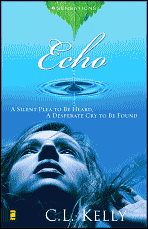
Echo by Clint Kelly (July 2007)
Age Range: Teen to Adult
Main character Cassie Dixons takes a relaxing vacation and goes to the Cascade Mountains with her friends, the Fergusons, and their teenage deaf son, Cody. While Cassie sees how Cody's mother is overprotective of him, she decides to encourage him to have confidence in himself and explore; yet, "Cassie aches for the boy, knowing that hearing is both the audible and inaudible ways in which we hear each other and God"(publisher release information). When Cody disappears, the peaceful vacation turns into a frantic search for his whereabouts that has Cassie feeling guilty.

Author Clint Kelly is a communications specialist for Seattle Pacific University.


Neither-Nor: A Young Australian's Experience with Deafness by Paul Gordon Jacobs (April 2007)
Age Range: Teen to Adult

This is the story of Paul Jacobs who lost his mother when he was three months old and then lost most of his hearing at five years old. In this memoir, Jacobs shares his experiences in the classroom and with sports, including his experience playing on the Deaf Australian World Cup cricket team for; and his experiences with the positive role models who supported him.

Some Kids Are Deaf by Lola M. Schaefer (September 2007)
Age Range: 8 to 12
Schaefer's book encourages appreciation for difference. This book is marketed more for those who are not familiar with deaf people.

Thursday, July 05, 2007

Deaf Education Conference and an Advance Reader's Copy!!!

Last week I attended the CAID (Council of American Instructors of the Deaf) Conference in Reno, NV where I presented on the portrayals and perceptions of Deaf Characters in Adolescent Literature (PICTURED RIGHT).
I handed out my 'Top 5 favorite books with Deaf Characters' bookmark (PICTURED LEFT)which was a difficult task because there are so many good books. Since I was flying and flying usually includes flight delays, I thought this trip was going to provide a great opportunity for me to read.

I brought Delia Ray Howard's Signing Hands (look for my interview with her later this month!) and some non-Deaf Character books (Yes, I do try to read books outside this genre). There were so many exciting presentations and activities (which included "hanging out" with one of my former students who lives in Reno and a Lake Tahoe riverboat cruise with my mom, Phyllis- PICTURED RIGHT) that I hardly had time to read!

While at the conference I picked up information about two programs encouraging literacy: 1.) Say It in Sign has produced "moving" American Sign Language greeting cards and Flashcards and 2.) Burton Vision has created a computer program that "builds bridges between American Sign Language and English". The program works for ASL users and those who wish to become fluent in ASL. I believe my favorite part is the "Classic Stories". Plus, Michael Burton gives one entertaining presentation!

This week I'm trying to catch up. I have added a few book titles to the "100+ and Counting" list AND I just received my Advance Reader's Copy of LEADING LADIES from Doug Cooney.
(THANK YOU AGAIN DOUG!)
*********************************************

Leading Ladies (November 2007-- not yet released)
By Marlee Matlin and Doug Cooney
Publication Date: November 2007
Simon & Schuster Children's Publishing
288 pages ISBN-10: 0-689-86987-8
Grades: 3rd and up

Just as Deaf Child Crossing focused on Megan at camp, and Nobody's Perfect focused on Megan's birthday party, Leading Ladies focuses on Megan wanting to be the star (shocker!!!) in her class' musical production of The Wizard of Oz. Megan's good friend from camp, Lizzie who attends the Illinois School for the Deaf transfers to Megan's public school. Lizzie had such a small role in Nobody's Perfect that I'm glad to see that this character is given a major storyline. Of course, there is going to be DRAMA (pun intended) with another friendship triangle (characters Cindy and Alexis are back too) and a musical production. Also in this book, Megan's family has a new dog named Solo (I remember crying and crying over Apples -- no spoilers here, read Deaf Child Crossing). Even without knowing if she will secure the part of Dorothy, Megan begins training Solo to be the best Toto possible. I can't wait to finish reading this book!

Saturday, June 30, 2007

New Books- To be Released

The Unheard: A Memoir of Deafness and Africa
by Josh Swiller
Publisher: Holt Paperbacks (September 4, 2007)
age: Teen- Adult
ISBN-10: 0805082107
Josh Swiller grew up encouraged by his family to use lipreading and hearing aids to "blend in" with the larger hearing world which never seemed to work. After college, Swiller set out to find a place so far removed that his deafness would become irrelevant. His quest to reconcile his deafness in an unforgiving hearing world leads him on a remarkable journey in an African village.

Great Deaf Americans (The Third Editions)
by Matthew S. Moore, Robert F. Panara
Publisher: Deaf Life Pr; 3 edition (December 2007)
ISBN-10: 0970587635

The third edition includes approximately 77 biographical profiles of deaf people in a variety of fields. Teachers, lawyers, advocates, artists, athletes, scholars, journalists, scientists, administrators, leaders, travelers, communications pioneers, an Art Deco architect, an innovative shoestring-budget ASL filmmaker, one of the world's finest botanical artists, and the “World’s Greatest Lifeguard” are here. Each chapter is illustrated with a picture and a detailed bibliography.
(Note: the book jacket for the Third Edition is unavailable at this time-- the Second Edition book jacket is included above.)


Special Stories for Disability Awareness: Stories and Activities for Teachers, Parents and Professionals
by Mal Leicester, Taryn Shrigley-Wightman
Publisher: Jessica Kingsley Publishers (August 30, 2007)
age: 4-11 with adult supervision
ISBN-10: 1843103907

This book provides stories that promote disability awareness and discussion among children aged 4–11 about universal issues such as fear, loss, feeling 'different', bullying, exclusion, joy, success, friendship and emotional growth. Each chapter features an engaging story, linked discussion and learning materials as well as suggestions for activities and photocopy-ready handouts.

Interview with Jean Ferris, author of Of Sound Mind (2001)

Interview with Jean Ferris, author of the award-winning Of Sound Mind.

Author Jean Ferris lives in San Diego, California with her husband. She has two daughters who grew up and became teachers. As a child, Jean Ferris moved quite often. With each new place she “eavesdropped on other people's conversations in an attempt to find clues to the local ways”, she “looked into the lighted windows of other people's houses at dusk as my father drove down the new streets” and she “kept a diary about what I did and how I felt and what I was thinking”. The eavesdropping, peeping and keeping a journal helped her write stories.

Jean Ferris attended Stanford University and earned a B.A. and M.A. in Speech Pathology and Audiology. She explains that this profession “turned out to be work I didn't enjoy and wasn't well-suited to”. She never even considered publishing one of her stories until later in her life. Now she has several published works including Of Sound Mind, the story of Theo and his entire Deaf family. I often recommend this book and it is certainly one of my favorites. You will find my recent interview with Jean Ferris (JF) below:

SPW: How did you get involved with writing a book about a Deaf family with a hearing son? Have you associated with Deaf people before?

JF: My college degree is in Speech Pathology and Audiology, so when I was in grad school I taught a class of pre-school deaf. Those were in the days when every deaf child was supposed to learn to speak, and even then that seemed wrong to me. I could see how frustrated these little toddlers were at not being able to express themselves. Besides, I loved the look of people signing--it seemed almost like art. Once I became a writer, I thought for years about using ASL in a story, but never could figure out how. Then I read an article in my local newspaper about the genetics of deafness, using a real family as illustration. The grandparents, parents and two out of three children were deaf. Even the dog was deaf! But one son was hearing--and I began to wonder what it would feel like to be in the minority within your own family. Bingo! There was my story.

SPW: When reading this book alone and with several of my students, we all decided that we wanted to “be” Ivy because she was just so COOL! What was your inspiration for her character? Do you believe that teens can be this well-adjusted?

JF: I'm not sure how well-adjusted Ivy is! She certainly has issues about her mother. But we all have issues about something--and some of us manage those issues better than others. I guess Ivy is a pretty good manager--but she's not perfect. Every now and then she has a meltdown. So, sure, I think teens can be well-adjusted. But that doesn't mean that they don't sometimes act irresponsibly or carelessly or irrationally. After all, their frontal lobes aren't finished developing!

SPW: When did you realize that you wanted to be a writer?

JF: I've known since I was a little girl that I wanted to be a writer. I wrote my first book when I was seven. We moved a lot when I was growing up and I was always the "new kid" at school, so I spent some lonely hours. I entertained myself by writing and reading--and reading is the best preparation for being a writer. It helps you learn what makes a good story.

SPW: Was it difficult to publish your books when you first began your career? What struggles did you have?

JF: It took me almost five years to sell my first book. I submitted short story manuscripts, and a couple of other book manuscripts, but nobody wanted them. I could have papered a room with my rejection slips. But I kept writing, kept submitting, and kept learning. I didn't have an agent, but luckily I didn't know how hard it was to sell a book without one, so I just kept submitting. Finally, an editor at the publishing house that still publishes me read my manuscript for Amen, Moses Gardenia (now out of print) and bought it. So my advice to any prospective writers is just keep at it. Sometimes persistence is more important than talent. And if you've got both, eventually you'll succeed.

SPW: What advice would you give to young people who are reading your books for the first time?

JF: The only advice I can give first time readers is to have an open mind about all the characters. None of them are perfect, but they all deserve compassion and understanding. Try to put yourself in the place of each character and see how that feels.


Of Sound Mind has received several awards and recommendations. See below:
Awards and Honors include:
American Library Association Best Books for Young Adults
Booklist Editors' Choice
Books for the Teen Age, New York Public Library
IBBY Honor Books
NCSS-CBC Notable Trade Book in the Field of Social Studies

Recommendations by:
Booklist, American Library Association, Starred Review
Bulletin of the Center for Children's Books
Horn Book
Kirkus Reviews
Publishers Weekly
School Library Journal
VOYA (Voice of Youth Advocates)

For more information about Jean Ferris’ books, visit: http://www.jeanferris.com/
For Teachers: Want a free Reading Guide? Visit:
http://www.holtzbrinckpublishers.com/images/Books/TeachersGuides/0374455848TG.pdf

Saturday, June 23, 2007

Authors Update


Below, read INTERVIEWS with:


*Professor/ Author JEAN ANDREWS, Ph.D.(posted June 20th);


*Author/ Playwright DOUG COONEY (posted June 18th); and


*Author/ Animal & Child Rights Activist GINNY RORBY (posted June 23rd).


Check back for future interviews, including Jean Ferris author of Of Sound Mind.

Interview with Hurt Go Happy author Ginny Rorby

From her website (http://www.ginnyrorby.com/), you will learn that author Ginny Rorby was a flight attendant and later became a writer of young adult books including, Dolphin Sky and Hurt Go Happy. She wasn’t always a great student. She was a poor student in high school and even dropped out of college. By the time that she turned 33, she understood the importance of education and returned to college.

The story includes thirteen-year-old Joey Willis who is deaf. Her mother forbids her to use sign language and insists that she read lips. Needless to say, Joey is often left out of conversations. That is until she meets Dr. Charles Mansell whose parents were deaf. Joey secretly begins to learn to sign. “Hurt Go, Happy” is American Sign Language for “the pain has ended.”

Hurt Go Happy is inspired by the true story of Lucy, a chimpanzee raised as a human child, and the culmination of ten years of research that includes one girl's determination to save the life of a fellow creature-one who shares ninety-eight percent of our DNA.

SPW: How did you get involved with writing a book about a deaf character? Have you met any people before who use sign language?

GR: For years I'd been reading about Koko, the sign-language using gorilla, and about Washoe, the first chimp to use sign, and was intrigued. In 1988, I read the Houston Chronicle article, mentioned in Hurt Go Happy about Lucy. At the time I was just entering grad school to work on an MFA in Creative Writing and had just started writing Dolphin Sky, my first novel, which has a similar plot. Anyway, I couldn't get that newspaper article out of my head. and shortly thereafter, I went to an author reading at Books and Books in Coral Gables, FL (where I was living.) The author was Ruth Sidransky, the book, In Silence: Growing Up Hearing in a Deaf World. The whole plot idea for HGH came to me right then and there. I started taking sign-language classes and read everything I could find on deafness and the deaf community. I knew no deaf people then and know only two or three now. When I read at Books and Books this past January, lots of people from Miami's deaf community came. They were very kind to me and my feeble attempts to sign. The highlight of the evening was my friend Mary Ellen Tracy, who interpreted for me. The hearing loved seeing what I read signed, and the staff at Books and Books had a little epiphany of their own. Deaf people can attend readings. Duh!

SPW: I read that the memory of the child Belinda who was abused was part of the inspiration for the novel. What was your inspiration for Joey Willis, the deaf character who goes against her mother’s wishes and learns sign language?

GR: As I said, I'd been reading a lot about deafness and was soon aware of the oralist vs. signing controversy. Personally, I believe in opening every door of opportunity. The more options a child has, the better his/her chance of success. I think parents who opt for the oral-only education are trying to ensure their child has all the doors open. As hearing people with a deaf child, they perhaps fail to see how much it means to all of us to know that they aren't --hearing or deaf. I adopted this struggle for Joey. There was no one I knew who was my inspiration for her and yet nearly everyone I know could be. We all overcome some disability, physical, mental, or emotional. Who isn't Joey on some level? How she became deaf was Belinda's legacy.

SPW: What kind of research did you do in order to make Joey’s character appear like a real deaf child?

GR: Tons! And I'm so grateful for your phrasing. I was terrified that as a hearing person I would get some aspect wrong. I'm still scared-silly that I did. There are 12 books in my library by deaf and/or hearing on the subject. I read them all once or twice. I continued to take sign, though shortly after I moved to Fort Bragg, it became impossible since the woman who taught it moved away. I made numerous trips to the California School for the Deaf and had an early manuscript vetted by a teacher there. It was also vetted by an English professor at Gallaudet. You probably know her. Tonya Stremlau.

SPW: In many ways it is probably difficult to tell this story since it includes abuse and neglect. What do you hope young people learn from this story?

GR: Responsibility. Animal and child abuse are our problems. I want them to recognize it when they see it and to see it when it's there. I want them to become sensitive to the suffering of others. I've received the most astonishing letters from kids who GOT IT. (The most poignant is on my website.) They have expressed interest in learning to sign, and want to help protect animals from research abuses. Their letters are my reward.

SPW: What advice would you give to young people who are reading your books for the first time?

GR: [Read] with an open heart, but that will sound dorky. There are some horrible things going on in the world. They are overwhelming sometimes, but if we just do the right thing in our own little corner, our school, with our friends, then that is where fixing what's wrong starts. I hope HGH empowers them. Read it knowing that you have the power.

SPW: Is there anything that you would like to add?

GR: I write back to anyone who writes me. ginnyrorby@mcn.org is my preferred address for mail from kids. Thank you for selecting Hurt Go Happy for inclusion.


For more information about Ginny Rorby and her inspirations for this story, visit: http://www.ginnyrorby.com/hurtgohappy-goodall.htm

Thursday, June 21, 2007

New Books Updated

Listening to Mondrian by Nadia Wheatley (not yet published)
Reading level: Young Adult
Paperback: 192 pages
Publisher: Allen & Unwin (December 1, 2007)
ISBN-10: 1741148758

Listening to Mondrian is a collection of short stories focusing on adolescents and their diverse family relationships. The characters analyze who they are and how they fit into their families, their communities, and the world. One short story includes a CODA (child of Deaf Adults) page 136 entitled "Alien".

Feathers by Jacqueline Woodson (2007)
Reading level: Ages 9-12
Hardcover: 208 pages
Publisher: Putnam Juvenile
ISBN-10: 0399239898

Set in 1971, main character, Frannie, enjoys analyzing Emily Dickinson's poem, "Hope is the thing with feathers/ that perches in the soul". When a new boy enters the school, the class bully nicknames him "Jesus Boy" because of his pale skin and long hair (and because the new student is the only white student in the classroom).

Frannie's brother, Sean, is deaf and uses sign language throughout the novel. The book covers issues such as the Vietnam War, adolescents' questions about God, issues of racial segregation and deafness.

The Mammoth Book of Golden Age SF: Ten Classic Stories from the Birth of Modern Science Fiction Writing by Isaac Asimov (Editor), Charles G. Waugh (Editor), Martin H. Greenberg (Editor) Paperback: 512 pages
Publisher: Carroll & Graf (2007)
ISBN-10: 0786719052

This is an anthology of classic Science Fiction stories. One of which, "E for Effort", includes deaf characters from the Arizona School for the Deaf. The emphasis is on their amazing lipreading abilities.

Wednesday, June 20, 2007

Interview with Professor/ Author JEAN ANDREWS, PH.D.

READ AN INTERVIEW WITH
PROFESSOR/AUTHOR JEAN ANDREWS, PH.D. BELOW **************************************************************
**************************************************************

Dr. Jean F. Andrews is the coordinator of graduate programs in Deaf Studies/Deaf Education within the Department of Deaf Studies/Deaf Education at Lamar University in Beaumont, TX. She has served on the governance board at the Texas School for the Deaf (TSD) in Austin, Texas and has been on the editorial board of the American Annals of the Deaf since 1986. Dr. Andrews began her career teaching at the Maryland School for the Deaf, I have conducted research in more than ten residential schools. On her website, she explains, “Like many of my colleagues, I recognize the value of the rich linguistic and cultural environments that well-run state schools for the deaf and large day programs that can provide full access to the dual languages: ASL and English.” Dr. Andrews is the author of the Flying Fingers Series which includes The Flying Fingers Club (1988); Secret in the Dorm Attic (1990); Hasta Luego, San Diego (1991); The Ghost of Tomahawk Creek (1993); and Mystery of the Totems (2001).

(picture of husband Jim and author Jean Andrews, Ph.D.)
SPW: How did you decide to become a teacher of the Deaf? Did you grow up with Deaf people?

JA: I went to college in Washington, DC and majored in English literature. I took an ASL class in my senior year at Gallaudet University nearby and was intrigued by the language. I went to McDaniel College (formerly Western Md College) and got my degree in deaf ed. I became immersed in the Deaf culture there. My first job was as a reading teacher at the Maryland School for the Deaf.


SPW: I recall reading that the Deaf Community played an important part of your research for writing the Flying Fingers Club Series. Can you explain your inspiration for the book?

JA: My classmates at McDaniel's, my colleagues at MSD and deaf students there and the deaf students I worked with in KY and in TX. I have many deaf colleagues around the country who I enjoy working on projects with. Deaf graduate students are a "source of inspiration and ideas" too.

SPW: Did you face any challenges as a hearing author writing about Deaf children?

JA: Yes its hard to adopt a "deaf voice" when you are hearing. Your "hearingness" naturally leaks through. That is why I always check my ideas with deaf colleagues and students. They are always very frank with me!

SPW: What advice would you give to young people who are reading your books for the first time?

JA: Read, read, read and read. It will open many doors for you...it will provide you with many more experiences than you can get in a usual lifetime. I like to read the newspaper in the morning, professional books at work and I read lots of fiction and non-fiction in the evenings and on weekends and on vacations. I love to read book reviews in Sunday newspapers and also browse at Barnes and Noble. I love used book stores too in cities when I travel...New Orleans has some good ones...as does Houston.SPW: What are your plans for writing another book in the series?

SPW: What are your plans for writing another book in the series?

JA: I am not writing a Flying Fingers club book now...I finished five of them (http://www.buttepublications.com/) and have published them on a CD as some of them are out of print. Research with students on language and literacy keeps me pretty busy these days. But I still like to write fiction and a story idea is always running through my head. Right now I am writing a magazine article on a famous deaf lifeguard named LeRoy Colombo. He attended the Texas School for the Deaf. I visit TSD a lot as I am a strong supporter of residential schools for the deaf and we have many Lamar students who go there to work when they graduate. LeRoy lived in Galveston Island from 1905 to 1974 and saved more than 900 people. I hope to turn this article into a book eventually. TSD named their natatorium* after LeRoy Colombo.

((*Natatorium= A building constructed for the purpose of housing a swimming pool and related equipment.))